What Is Search Engine Trust and How to Build It


TL;DR:
- Search engine trust combines technical signals, content credibility, user behavior, and authority to influence rankings. It is an ongoing, composite evaluation that many marketers overlook by focusing only on backlinks or keywords. Building trust requires continuous maintenance of technical health, verified content, and positive user engagement to ensure long-term search visibility.
Search engine trust is the aggregate evaluation of a website's credibility, authority, and reliability that algorithms use to determine ranking and visibility. It is not a single score you can check in a dashboard. Search engines like Google assess trust through multiple overlapping signals, including the E-E-A-T framework (Experience, Expertise, Authoritativeness, and Trustworthiness), technical site health, user behavior patterns, and content quality. Understanding what is search engine trust gives digital marketers a concrete target: build the conditions that make algorithms confident your site deserves to rank.
What is search engine trust, and why does it matter for rankings?
Search engine trust is not a single public score. It is an emergent result of multiple algorithmic assessments across crawling, indexing, ranking, and user satisfaction. That distinction matters because marketers who chase a single "trust metric" are solving the wrong problem.Google's E-E-A-T framework is the most widely used model for understanding search engine credibility. It evaluates whether content demonstrates real-world experience, domain expertise, recognized authority, and verifiable trustworthiness. Each dimension feeds into how algorithms weight your pages against competing results.
The importance of search engine trust extends beyond rankings. A site that algorithms trust gets crawled more frequently, indexed more completely, and surfaced more consistently in competitive queries. Sites with weak trust signals may rank temporarily but lose ground as algorithms recalibrate. Trust is the foundation that makes every other SEO tactic work.
Understanding search engine authority also means recognizing that trust is dynamic. Algorithms continuously reassess signals rather than locking in a judgment. A site that earned strong trust signals two years ago can lose ground if content grows stale, backlinks decay, or user engagement drops.
What factors contribute to search engine trust?
Trust signals fall into four distinct categories, and each one carries weight in how algorithms assess your site.
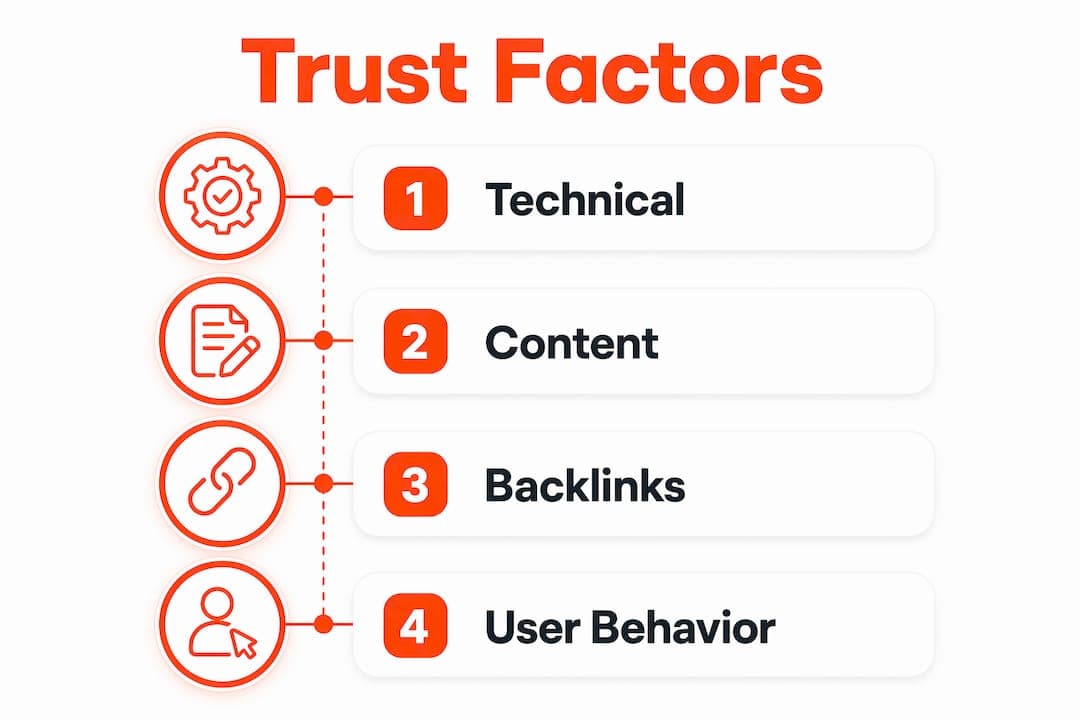
| Category | Key signals | What it tells search engines |
|---|---|---|
| Technical | HTTPS, site speed, mobile-friendliness, crawlability | The site is safe, accessible, and professionally maintained |
| Content | E-E-A-T, authorship, accuracy, freshness | The content is credible, current, and written by qualified sources |
| User behavior | Click-through rate, dwell time, return visits | Real users find the content relevant and satisfying |
| Authority | Backlink quality, entity recognition, topical depth | Other credible sources vouch for the site's expertise |

Content trust signals go deeper than grammar and accuracy. Verifiable accountability through identifiable authors, clear ownership, and evidence-backed claims aligns directly with quality frameworks. Bylines with real credentials, transparent "About" pages, and cited sources all contribute to how algorithms assess content credibility.
Trust signals also include identity verification, expertise credentials, authoritative backlinks, social proof, security marks, transparency policies, content recency, and guarantees. Each one adds a layer of confidence for both users and search engines. The cumulative effect is what separates sites that rank consistently from those that fluctuate.
Pro Tip: Fix technical trust signals first. HTTPS, page speed, and mobile usability are table stakes. Authoritativeness improvements built on a shaky technical foundation will not hold.
How do search engines infer trust from user behavior?
Google's trust ranking patent describes a mechanism where user behavior creates implicit trust relationships between sites and their audiences. This is one of the least understood factors affecting search engine trust, and it has direct implications for how you structure your content and user experience.
The patent outlines several key mechanisms:
- Click behavior: Users who click a result and stay signal that the page satisfied their intent. High dwell time tells the algorithm the content delivered on its promise.
- Trust propagation: Trusted sites that link to or label other sites pass a form of credibility. The trust relationship flows through the link graph, not just through anchor text.
- Implicit trust buttons: User actions like bookmarking, sharing, or returning to a site function as implicit endorsements that feed back into ranking signals.
- Decay patterns: Trust signals are not permanent. Declining engagement, rising bounce rates, or reduced return visits cause trust scores to decay over time.
- No single metric: Google's trust patent confirms there is no single trust rank metric. The algorithm synthesizes behavior signals into a composite assessment.
What this means practically is that user experience and content quality are trust signals, not just conversion factors. A page that loads slowly, buries the answer, or frustrates the reader is actively degrading its own trust profile with every visit.
Pro Tip: Encourage positive engagement by answering the search query in the first paragraph, using clear headings, and making navigation obvious. Every satisfied user strengthens your trust signal.
Why is search engine trust more critical in AI-driven search?
AI search assistants have changed what trust means in practice. Traditional SEO rewarded sites that ranked well in blue-link results. AI-driven search rewards sites that get cited as sources in generated answers. The bar for the second category is significantly higher.
| Factor | Traditional SEO | AI-driven search |
|---|---|---|
| Primary goal | Rank on page one | Get cited in AI-generated answers |
| Content evaluated by | Keyword relevance, backlinks | Source credibility, groundability, factual accuracy |
| Trust signals weighted | Domain authority, on-page SEO | First-party data, verifiable authorship, citation quality |
| Freshness impact | Moderate | High, continuously recalculated |
| Trust decay | Slow | Fast, updated with each query cycle |
A 2026 study on web search credibility in chat assistants found measurable differences in how AI systems evaluate and cite sources. Source attribution and reliability now directly affect visibility in AI-generated results. This is a structural shift in what impacts search engine trust.
The proliferation of AI-generated content has also raised user skepticism. Readers are more likely to question sources, and AI assistants are calibrated to reflect that skepticism. Lack of trust means content may rank but won't be selected or cited, which limits visibility precisely where AI search is growing fastest.
Pro Tip: Add third-party citations, named authors with credentials, and verifiable data points to every key content piece. AI assistants use these signals to assess whether your content is safe to cite.
How can digital marketers build and maintain search engine trust?
Building search engine credibility is a sustained practice, not a one-time project. The most effective approach combines technical hygiene, content accountability, and active user experience management.
Start with the non-negotiables. HTTPS, fast load times, mobile optimization, and accessible design are prerequisites. Without them, every other trust-building effort is undermined before it starts. Run a technical SEO audit regularly to catch regressions before they compound.
Content trust requires verifiable authorship. Publish real author bios with credentials, link to their professional profiles, and update content when facts change. Topical consistency also matters. A site that covers ten unrelated subjects signals shallow expertise. A site with deep coverage of a defined topic area builds the kind of entity recognition that algorithms reward.
Internal linking reinforces trust flow across your site. When you link from a high-authority page to a newer one, you pass credibility through your own domain. This is one of the fastest ways to accelerate trust for new content. Babylovegrowth's approach to building trust online covers this in detail, including how to structure internal links for maximum authority transfer.
Avoid these five trust-destroying mistakes:
- Misleading authorship: Fake bylines or unqualified authors damage E-E-A-T assessments and are difficult to recover from.
- Fabricated reviews: Deceptive practices like fake social proof destroy trustworthiness quickly and take a long time to rebuild.
- Stale content: Outdated statistics, broken links, and obsolete advice signal neglect to both users and algorithms.
- Thin content: Pages that exist to target keywords without delivering real value erode topical authority over time.
- Ignoring engagement signals: High bounce rates and low dwell time are trust signals. Ignoring them means ignoring direct feedback from your audience.
Understanding search engine signals and how they interact gives you the framework to prioritize fixes and improvements in the right order.
Key Takeaways
Search engine trust is a composite, dynamic evaluation built from technical signals, content credibility, user behavior, and authority, and it directly determines whether your site ranks, gets cited, or gets ignored.
| Point | Details |
|---|---|
| Trust is not one score | Algorithms assess trust through multiple overlapping signals across crawling, indexing, and user behavior. |
| E-E-A-T is the core framework | Experience, Expertise, Authoritativeness, and Trustworthiness guide how Google evaluates content credibility. |
| Technical signals come first | HTTPS, speed, and mobile-friendliness are prerequisites before authoritativeness improvements deliver results. |
| AI search raises the bar | AI assistants prioritize source credibility and verifiable authorship when selecting content to cite. |
| Trust decays without maintenance | Stale content, declining engagement, and deceptive practices erode trust faster than most marketers expect. |
The trust signal most marketers underestimate
Most SEO professionals I work with focus on backlinks and keyword density when they think about authority. Those matter. But the signal that consistently surprises clients is engagement decay. A site can have strong domain authority and excellent content, and still lose ranking ground because user behavior signals have quietly deteriorated over 18 months.
Trust is not a trophy you earn once. It is a probability that algorithms update continuously based on how users interact with your content right now. I have seen sites with mediocre backlink profiles outrank established domains simply because their content answered questions clearly, loaded fast, and kept users engaged. The algorithm noticed.
The shift to AI-driven search makes this even more consequential. When ChatGPT, Claude, or Perplexity selects a source to cite, it is not just looking at domain authority. It is evaluating whether the content is grounded, attributable, and verifiable. That is a much higher standard than traditional ranking, and most sites are not meeting it yet. The marketers who build for that standard now will hold a significant advantage as AI search continues to grow.
My honest recommendation: treat trust-building as a core business practice, not an SEO task. Transparent authorship, accurate content, and genuine user value are not just ranking factors. They are the conditions under which your brand earns the right to be cited.
— MEET
Babylovegrowth's tools for building search authority
Search engine trust requires the right signals working together: authoritative content, quality backlinks, and technical site health. Babylovegrowth brings all three into one platform built for digital marketers who need results at scale.
The keyword discovery platform identifies high-value topics where your site can build genuine topical authority, not just chase volume. Pair that with Babylovegrowth's backlink building software to acquire quality links that signal credibility to both Google and AI-driven search engines. The platform also runs automated technical audits, structured data markup, and internal linking, covering every layer of trust signal that algorithms assess. For marketers serious about sustainable rankings, Babylovegrowth handles the infrastructure so you can focus on content that earns trust.
FAQ
What is search engine trust in simple terms?
Search engine trust is the combined assessment of a website's credibility, authority, and reliability that algorithms use to decide how prominently to rank its pages. It emerges from technical signals, content quality, backlinks, and user behavior rather than any single metric.
How does Google measure website trustworthiness?
Google uses the E-E-A-T framework alongside technical signals, user engagement patterns, and backlink quality to assess trustworthiness. No single public trust score exists; the evaluation is a composite of ongoing algorithmic signals.
Why does search engine trust matter for AI search results?
AI assistants like ChatGPT and Perplexity select sources based on credibility, groundability, and verifiable authorship. Sites with strong trust signals are more likely to be cited in AI-generated answers, which is now a primary visibility channel.
How long does it take to build search engine credibility?
Trust builds gradually through consistent technical maintenance, content quality, and engagement. Deceptive practices can destroy trust quickly, but rebuilding it after a credibility loss typically takes significantly longer than the initial build.
What is the fastest way to improve search engine trust?
Fix technical signals first: implement HTTPS, improve page speed, and ensure mobile-friendliness. Then add verifiable authorship and update stale content. These steps address the foundational signals that all other trust improvements depend on.