










Master basic Spanish: beginner steps for real conversations

You're standing at a café counter in Madrid, the waiter is waiting, and your mind goes completely blank. It happens to almost every beginner. The good news is that this frustration is not a sign you're bad at languages. It's a sign you haven't yet built a reliable system. This guide gives you that system: a practical, step-by-step framework for mastering basic European Spanish so you can start speaking from day one with greetings, introductions, polite requests, and everyday needs.
Table of Contents
- What you need to begin: tools and expectations
- Step 1: Memorise practical phrases for daily life
- Step 2: Use active recall and simple practice routines
- Step 3: Fix common mistakes and Spanish 'gotchas'
- How to check your progress quickly
- Next steps: take your Spanish further
- Frequently asked questions
Key Takeaways
| Point | Details |
|---|---|
| Start with essentials | Focus on memorising everyday phrases for greetings and needs first. |
| Active recall matters | Use daily speaking and writing routines to fix phrases in your memory. |
| Tackle common mistakes | Address tricky grammar and pronunciation early to avoid confusion. |
| Test your progress | Check your skills by simulating real conversations and practical checkpoints. |
What you need to begin: tools and expectations
Before you learn a single phrase, it helps to know exactly what you're aiming for. The goal here is not fluency. It's reaching CEFR A1, the level where you can handle simple, familiar situations: buying bread, asking for directions, introducing yourself to a neighbour. That's a genuinely achievable target, and A1 basics require roughly 60 to 100 hours of focused exposure to cover the core communication you need.
That might sound like a lot, but spread across daily 30-minute sessions, you're looking at four to six months of comfortable, pressure-free learning. The key word is focused. Passive listening while you cook dinner won't get you there. Active engagement will.
Here are the tools worth having from the start:
- A vocabulary notebook (physical or digital) for your personal word bank
- A dictionary app such as WordReference for quick lookups
- Flashcard software such as Anki for spaced repetition practice
- A reliable beginner course that explains Spanish in plain English, not grammar jargon
- A pronunciation tool to hear how words actually sound in Spain
| Tool | Purpose | Cost |
|---|---|---|
| Vocabulary notebook | Build your personal word bank | Free |
| WordReference app | Quick, accurate translations | Free |
| Anki flashcards | Spaced repetition for recall | Free |
| Beginner course | Structured sentence building | Varies |
| Pronunciation audio | Hear real Spanish speech | Free/paid |
One myth worth busting immediately: adults are not worse language learners than children. Adults actually have a significant advantage because they can use logic, pattern recognition, and deliberate strategy. Children learn through years of immersion. You can shortcut that process considerably with the right approach.
Pro Tip: Before you start any lesson, write down ten words or phrases that are specific to your life. If you're moving to Spain, you might need words for your local market, your doctor's surgery, or your town hall. A personalised word bank beats a generic vocabulary list every time.
Step 1: Memorise practical phrases for daily life
With your tools ready, it's time to focus on the phrases you'll actually use. Forget abstract grammar rules for now. The fastest route to confidence is memorising a core set of phrases that cover the situations you'll face most often.
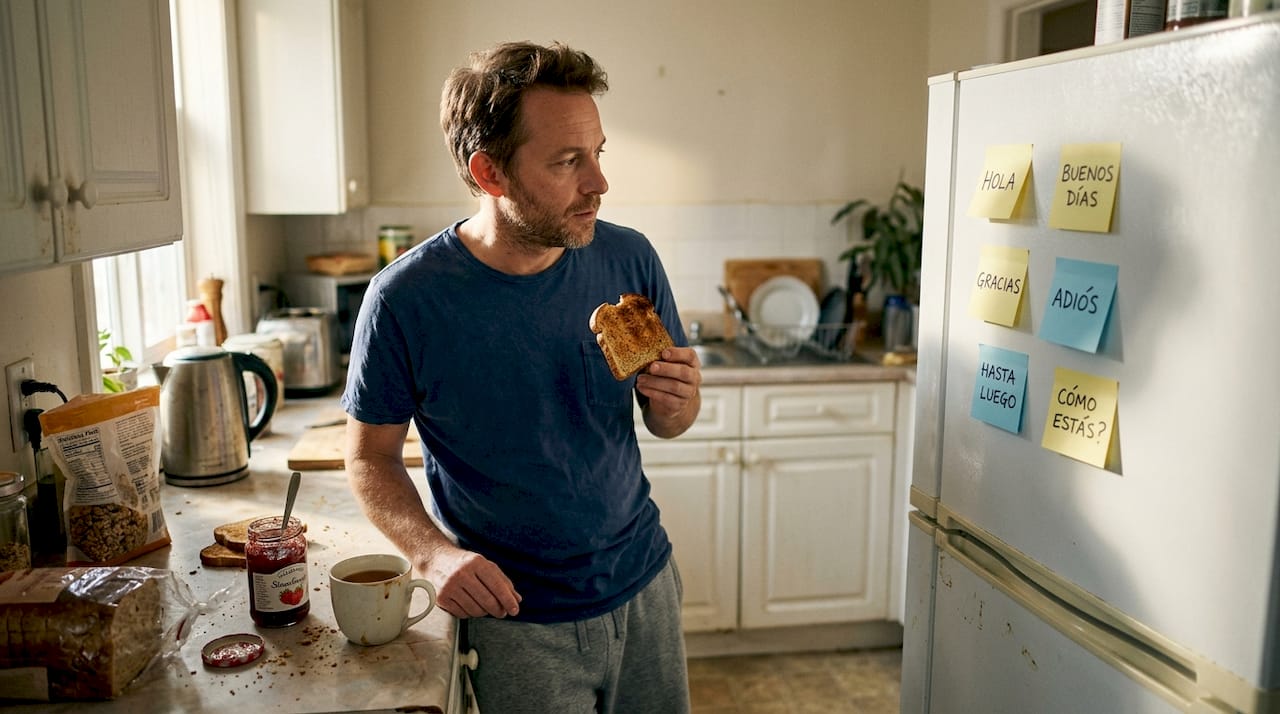
Think in groups. Greetings and farewells. Introductions. Polite requests. Asking for help. Everyday needs like shopping, ordering food, and catching a bus. These five groups cover the vast majority of beginner interactions.
Here's a comparison of the phrases you need most:
| English | Spanish | When to use it |
|---|---|---|
| Good morning | Buenos días | Morning greeting |
| Good afternoon | Buenas tardes | Afternoon greeting |
| Please | Por favor | Any polite request |
| Thank you | Gracias | After receiving help |
| Excuse me | Perdona / Perdone | Getting attention |
| Do you speak English? | ¿Habla inglés? | When you're stuck |
| I don't understand | No entiendo | Asking for clarity |
| How much does it cost? | ¿Cuánto cuesta? | Shopping |
| Where is...? | ¿Dónde está...? | Asking directions |
| I would like... | Quisiera... | Ordering or requesting |
Your non-negotiable first phrases to memorise are:
- Hola (hello) and Adiós (goodbye)
- Por favor (please) and Gracias (thank you)
- Me llamo... (my name is...)
- No entiendo (I don't understand)
- ¿Puede repetir, por favor? (Can you repeat that, please?)
- ¿Dónde está...? (Where is...?)
- Quisiera... (I would like...)
Why do these matter so much? Because they are conversation openers. Once you say Hola, quisiera un café, por favor, you've started a real exchange. You can find Spanish sentence examples that show how these building blocks connect into natural speech.
Pro Tip: Practise these phrases aloud, alone, until they feel completely automatic. Say them in the shower, on a walk, while waiting for the kettle. The goal is zero hesitation before you ever use them with a native speaker.
Step 2: Use active recall and simple practice routines
Knowing your phrases is one thing. Having them ready when you need them is another. The difference comes down to how you practise. Passive review, reading over your notes, is far less effective than active recall methods such as spaced repetition, shadowing, and sentence writing.
Active recall means forcing your brain to produce Spanish, not just recognise it. Cover the Spanish column in your table and say the phrase from memory. Write a sentence without looking at your notes. These small acts of retrieval are what build genuine fluency.
Here is a simple daily five-step routine:
- Review (5 minutes): Go through yesterday's flashcards and say each phrase aloud.
- New input (10 minutes): Learn three to five new phrases or words from your course.
- Shadowing (5 minutes): Listen to a short audio clip of native Spanish and repeat each sentence immediately after, matching the rhythm and tone.
- Sentence writing (5 minutes): Write three original sentences using today's new vocabulary.
- Self-test (5 minutes): Cover your notes and recall everything from today's session.
That's a 30-minute session. Consistent and manageable. Shadowing deserves a special mention because it does two things at once: it trains your ear to follow natural speech patterns, and it trains your mouth to produce sounds correctly. It's one of the most efficient tools available to a beginner.
"Daily 30 to 45 minutes of active exposure using spaced repetition, comprehensible input, and shadowing produces significantly faster results than longer but passive study sessions."
You can find structured grammar exercises that complement this routine and help you build sentences with confidence rather than guesswork.
Step 3: Fix common mistakes and Spanish 'gotchas'
Now you're practising, it's essential to get ahead of the mistakes that trip up almost every English-speaking beginner. Some of these are predictable, and knowing them in advance saves you from cementing bad habits.
The biggest stumbling block for most beginners is ser versus estar. Both mean "to be" in English, but they are not interchangeable. Ser is used for permanent or defining characteristics: nationality, profession, identity. Estar is used for temporary states or locations: how you feel today, where something is right now. A simple rule: if it could change tomorrow, use estar.
Gender agreement catches people out too. Every Spanish noun is either masculine or feminine, and the adjective must match. Un libro rojo (a red book, masculine) versus una mesa roja (a red table, feminine). A quick checking trick: always ask yourself whether the noun ends in -o (usually masculine) or -a (usually feminine), then match your adjective accordingly.
False friends are another trap. Embarazada does not mean embarrassed. It means pregnant. Sensible does not mean sensible. It means sensitive. These strategic recall techniques help you flag and remember these tricky exceptions before they cause awkward moments.
Here are the top five beginner mistakes and their fixes:
- Mixing up ser and estar: Learn one clear rule for each and test with real examples.
- Forgetting gender agreement: Check noun endings and match adjectives every time.
- Translating word for word from English: Spanish sentence order is different. Learn phrases as whole units.
- Ignoring pronunciation: A mispronounced word can mean something completely different. Use audio tools.
- Relying on false friends: Keep a short list of the most common ones and review it regularly.
You can practise basic sentence structure with exercises that highlight these exact patterns so you build correct habits from the start.
Pro Tip: Record yourself saying five sentences, then play them back. You'll immediately notice pronunciation issues and hesitations that you don't catch when speaking in real time. It feels uncomfortable at first, but it accelerates improvement faster than almost anything else.
How to check your progress quickly
After focused practice and error correction, you need a reliable way to know whether it's actually working. Self-assessment is not about being harsh on yourself. It's about building genuine confidence before you step into a real conversation.
Here is a simple self-test routine:
- Ordering food: Can you walk through a full café order in Spanish without hesitating? Un café con leche y una tostada, por favor.
- Asking directions: Can you ask where the nearest pharmacy is and understand a simple reply?
- Making introductions: Can you introduce yourself, say where you're from, and ask someone's name?
- Handling a problem: Can you say you don't understand and ask someone to speak more slowly?
- Shopping: Can you ask the price of something and respond to the answer?
If you can do all five comfortably, you're at a solid A1 level. If one or two feel shaky, that's your signal to repeat those specific scenarios rather than moving on. Adults excel with strategic recall and targeted repetition rather than trying to absorb everything at once.
Role-play is one of the most underused self-check tools. Set up a pretend scenario at home: you're at a market stall, a doctor's reception, or a bus station. Talk yourself through it out loud. It feels silly, but it mirrors the pressure of a real situation far better than silent revision.
When you can handle all five checkpoints without notes, you're ready to move beyond the basics.
Next steps: take your Spanish further
Building a solid foundation with the right phrases, a consistent practice routine, and an awareness of common mistakes gives you a real head start. But structure and self-study only take you so far. Having a guide who explains Spanish in plain, straightforward English, without drowning you in grammar terminology, makes the whole process faster and far less frustrating.
James Spanish School was built precisely for English-speaking adults who want to speak real, everyday Spanish rather than pass an academic exam. Founded by James Bretherton, a dual-native speaker who has lived in Spain for 40 years, the school uses a method called Radical Simplification. The 100-lesson course covers sentence building and ear-tuning so you can follow fast spoken Spanish, and everything is available on demand, 24/7, with no expiry date and no pressure. If you're ready to move from hesitation to genuine confidence, it's a natural next step.
Frequently asked questions
How long does it take to master Spanish basics?
With daily practice, most adults can reach a working A1 level in 60 to 100 hours, covering the core communication needed for everyday situations such as greetings, shopping, and asking for help.
Should I start with vocabulary or grammar?
Start with key vocabulary and practical phrases first. Avoiding grammar-first overload prevents the stalling that stops so many beginners in their tracks, and it builds real confidence much faster.
What's the fastest way to remember new Spanish words?
Use spaced repetition and active recall by producing words from memory rather than just reading them. Writing or saying a word from scratch is far more effective than passive review.
How can I avoid mixing up ser and estar?
Learn one simple rule for each verb: ser for defining characteristics, estar for temporary states and locations. Strategic recall with real examples cements the difference far more reliably than memorising abstract grammar rules.