Search Engine Signals: What They Mean for Rankings


TL;DR:
- Search engine signals are indicators that assess a web page’s relevance, trustworthiness, and authority for ranking purposes. These signals include structured data, backlinks, user behavior, and content freshness, all evaluated in under 500 milliseconds to determine search rankings. Building a balanced architecture that integrates trust, authority, and relevance signals consistently improves visibility and ranking performance.
Search engine signals are the specific indicators that search engines use to assess the relevance, trustworthiness, and authority of web pages when delivering results. The meaning of search engine signals comes down to one core function: they tell Google and AI-driven engines like Perplexity and Claude whether your content deserves to rank. Modern systems evaluate hundreds of signals in under 500 milliseconds for every query. That speed means the evaluation is automated, layered, and unforgiving. Marketers who understand how these signals work hold a real advantage over those who treat SEO as a keyword count exercise.
What is the meaning of search engine signals?
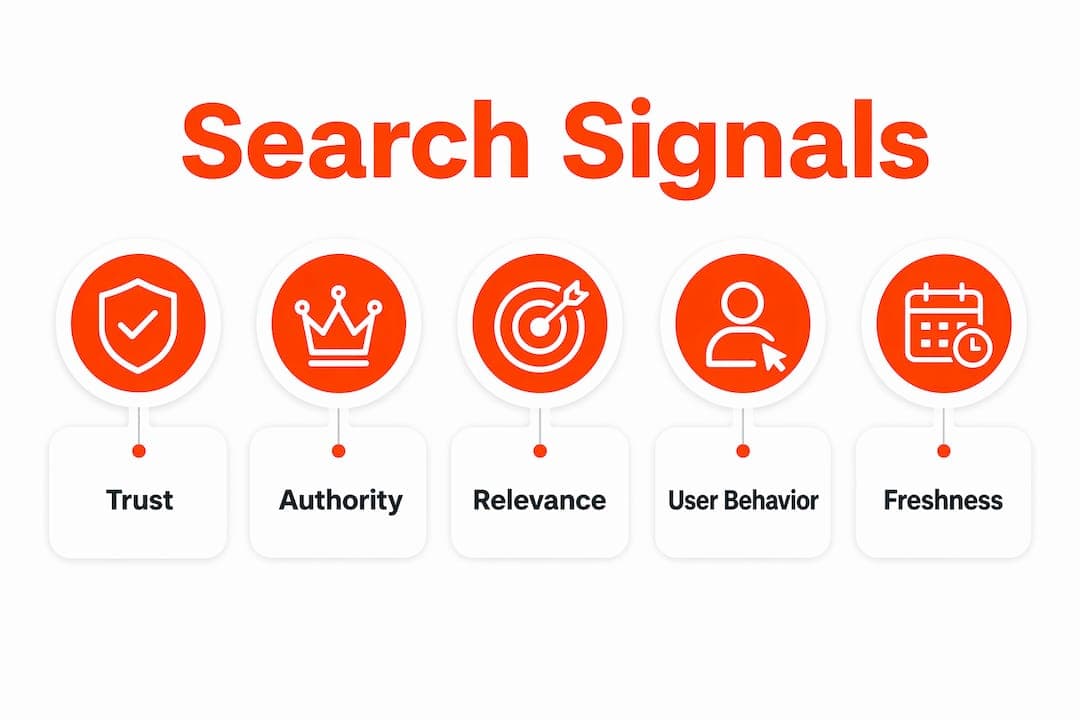
Trust, authority, and relevance signals form the decision layer search engines use to select and rank content. Each category answers a different question. Trust proves identity. Authority confirms expertise. Relevance confirms topical fit. These three categories do not operate independently. They function as an integrated evaluation system, and weakness in one category limits the impact of the other two.
Search engine ranking signals are not a checklist. They are a decision layer that weighs dozens of inputs simultaneously. Google's E-E-A-T framework (Experience, Expertise, Authoritativeness, and Trustworthiness) reflects exactly this architecture. A page can have strong backlinks but still rank poorly if its content fails the relevance test.
| Signal type | Primary sources | Examples |
|---|---|---|
| Trust | Schema markup, authorship, sameAs references | Organization schema, verified author profiles |
| Authority | Backlinks, internal links, knowledge graph | Referring domains, Wikipedia connections |
| Relevance | Content, keywords, semantic structure | Topic coverage, heading hierarchy, structured data |
Pro Tip: Implement Organization schema with sameAs references pointing to your Wikipedia page, LinkedIn profile, and Wikidata entry. Without these, AI systems treat your site as an anonymous source and deprioritize it for citation.
Understanding search engine signals at this level separates reactive SEO from deliberate visibility strategy. Each signal type reinforces the others. A site with strong identity trust earns more authoritative backlinks. A site with authoritative backlinks gets crawled more frequently, which improves freshness signals.
How do search engine signals work in modern ranking algorithms?
Search engines answer two master questions for every query: is this content relevant, and is this source authoritative? The entire ranking architecture flows from those two questions. Hundreds of signals feed into both answers simultaneously, processed in under 500 milliseconds. That speed is only possible because the evaluation is algorithmic, not human.
Traditional SEO foundations like PageRank still operate, but they now sit beneath an AI-driven extraction and retrieval layer. This layer does not read full articles. It extracts atomic content fragments, favoring structured content with clear hierarchy and concise definitions. A well-written 2,000-word article with poor heading structure loses citation eligibility to a 600-word piece with clean H2/H3 blocks and a definition in the first paragraph.
Google's ranking architecture relies primarily on Quality and Popularity as master ranking inputs. Quality maps to authority and trust. Popularity maps to user signals and links. These two inputs compound each other. A page that earns strong links also earns more visits, which feeds Chrome browsing data back into the Popularity signal.Behavioral signals now carry confirmed weight. User interaction data, including click-through rates and dwell time, feeds directly into the ranking model. This means content quality is not just a writing standard. It is a measurable ranking input.
- Relevance signals: keyword presence, semantic coverage, heading structure, entity mentions
- Authority signals: referring domains, internal link architecture, knowledge graph connections
- Trust signals: schema markup, authorship verification, sameAs references
- Popularity signals: Chrome browsing data, NavBoost interaction patterns, visit frequency
- Freshness signals: publication date, update frequency, content version history
Pro Tip: Structure your content with clear H2/H3 headings, definition blocks, and data tables. Pages with this architecture are preferred for AI extraction and citation, which directly increases your visibility pool eligibility.
Why are first-party signals, freshness, and trust crucial for SEO success?
AI systems prioritize first-party signals such as original research and proprietary insights over generic recycled content. First-party signals reduce ambiguity. They give search engines a verifiable truth source that generic content cannot provide. A brand that publishes original survey data, internal case studies, or expert commentary earns a signal category that competitors copying industry articles simply cannot replicate.Freshness operates as a trust reinforcement loop. Continuous content updates signal ongoing accuracy and increase inclusion likelihood in AI retrieval pools. A page published in 2022 and never updated sends a stale signal, even if the information remains accurate. Search engines interpret inactivity as potential obsolescence. Regular updates to existing content, not just new publications, keep the freshness signal active.
Trust is not a one-time achievement. It requires consistent verification and ongoing maintenance. Identity signals like Organization schema must stay current. Author profiles must remain active and linked. Content must reflect current standards and data. Marketers who treat trust as a setup task rather than an ongoing practice lose ground to competitors who maintain it continuously.
Best practices for maintaining first-party signals and freshness:
- Publish original research, surveys, or proprietary data at least quarterly
- Update high-traffic pages every 90 days with new data, examples, or expanded sections
- Maintain active author profiles with verifiable credentials and consistent publishing history
- Connect your Organization schema to external knowledge sources via sameAs references
- Track content performance and prioritize updates for pages with declining traffic
The importance of content freshness extends beyond rankings. Fresh content earns more backlinks, generates more social signals, and keeps users returning. Each of those outcomes feeds back into the authority and popularity signals, creating a compounding effect.
Pro Tip: When you update existing content, change the publication date only if the update is substantive. Adding a sentence does not qualify. Rewriting a section with new data does. Search engines recognize cosmetic updates and do not reward them.
How do backlinks and user behavior influence authority and popularity signals?
Backlinks establish crawl priority and baseline trust needed for AI retrieval pools. They remain the infrastructure of authority. Without a minimum threshold of quality backlinks, a page does not enter the crawl priority queue that feeds AI citation systems. Backlinks are not optional for competitive rankings. They are the entry fee.
The quality of referring domains matters more than raw count. An analysis of 11.8 million results found that pages with higher numbers of unique referring domains rank higher and earn greater AI citation likelihood. This means link diversity, not just link volume, drives the authority signal. Ten links from ten different authoritative domains outperform fifty links from one domain.
Chrome browsing data and NavBoost interaction patterns feed directly into Google's Popularity ranking signal. Pages that earn frequent visits from organic search gain a compounding advantage. High visit frequency signals user satisfaction, which Google interprets as quality confirmation. This creates a feedback loop where well-ranked pages earn more visits, which reinforces their ranking.
The synergy between link authority and visit frequency is the most underappreciated dynamic in SEO. A page with strong backlinks earns higher initial rankings. Higher rankings generate more clicks. More clicks generate more behavioral data. That behavioral data feeds the Popularity signal, which further reinforces the ranking. Marketers who build quality backlinks while producing content that earns genuine engagement activate both sides of this loop.
Ranking signals are interdependent. Domain authority cannot compensate for thin content, and strong content cannot compensate for zero backlinks. Both inputs must meet a minimum threshold before either produces meaningful ranking impact.What practical steps can marketers take to optimize for search engine signals?
Optimizing for search engine ranking signals requires a structured approach across all three signal categories. No single tactic covers all three. Marketers who focus only on content miss the authority layer. Those who focus only on backlinks miss the trust and relevance layers.
- Implement structured data. Add Organization schema with sameAs references to your site. Connect your identity to Knowledge Graph sources. This is the foundation of trust signal architecture.
- Publish semantically rich content. Cover topics comprehensively, not just superficially. Use clear H2/H3 heading hierarchies. Include definition blocks and data tables to improve AI extractability.
- Build topically relevant backlinks. Prioritize links from domains in your industry. A backlink from a topically aligned site carries more relevance signal weight than a generic directory link.
- Update content consistently. Treat your top-performing pages as living documents. Schedule quarterly reviews. Add new data, expand thin sections, and remove outdated information.
- Audit technical performance. Site speed and mobile usability affect user experience signals. Slow pages generate higher bounce rates, which feeds negative behavioral data into the Popularity signal.
- Publish original data. Conduct surveys, analyze your own customer data, or document proprietary case studies. First-party content earns citations that recycled content cannot.
Pro Tip: Monitor your SEO ranking factors continuously, not just during audits. Trust signals degrade when schema markup breaks, author profiles go inactive, or content becomes outdated. Set calendar reminders for quarterly signal reviews.
The impact of search engine signals compounds over time. Marketers who build all three signal categories consistently outperform those who optimize in bursts. Sustained effort beats periodic campaigns every time.
Key Takeaways
Search engine signals work as an integrated system where trust, authority, and relevance must all meet minimum thresholds before any single factor produces meaningful ranking gains.
| Point | Details |
|---|---|
| Three core signal types | Trust, authority, and relevance each answer a different ranking question and must work together. |
| Speed of evaluation | Search engines process hundreds of signals in under 500 milliseconds, making consistent signal quality non-negotiable. |
| First-party content wins | Original research and proprietary data outperform recycled content in AI-driven search environments. |
| Backlinks remain foundational | Unique referring domains predict both rank and AI citation likelihood based on analysis of 11.8 million results. |
| Freshness is a trust signal | Regular content updates maintain inclusion in AI retrieval pools and reinforce ongoing trust evaluation. |
What I've learned about signals that most SEO guides miss
Most SEO content treats signals as a list of boxes to check. After working with dozens of brands on visibility strategy, the pattern I see most often is not a missing tactic. It is a missing architecture.
Businesses that struggle with rankings almost always have the same problem: they optimized for one signal category and ignored the others. They built backlinks but never implemented schema. They published great content but never earned a single referring domain. They updated their blog but let their Organization schema point to a dead LinkedIn page. Each of these is a signal gap, and signal gaps do not average out. They create ceilings.
The shift I find most underappreciated is the move from keyword targeting to identity trust. In 2026, a site without verified identity signals is effectively anonymous to AI retrieval systems. That anonymity is not penalized. It is simply ignored. Your content does not get demoted. It does not get considered at all. That distinction matters because it changes the urgency. You are not fixing a penalty. You are entering a visibility pool you are currently excluded from.
The freshness loop is the other area where I see consistent underinvestment. Marketers publish content and move on. But updating old content is one of the highest-return activities in SEO. A well-ranked page from two years ago, refreshed with current data and expanded sections, often outperforms a new article on the same topic. The existing authority signal gives it a head start. The freshness update reactivates it.
The practical lesson is simple. Build all three signal categories in parallel. Do not wait until your content is perfect to build backlinks. Do not wait until you have backlinks to implement schema. Start all three simultaneously and iterate on each.
— MEET
Babylovegrowth: AI tools built for every search engine signal
Babylovegrowth gives digital marketers and business owners a single platform to address all three signal categories at once. The keyword discovery platform identifies high-intent keywords aligned with real searcher behavior, feeding your relevance signal from day one. The backlink building software automates quality link acquisition at scale, building the authority infrastructure your rankings depend on.
Babylovegrowth also includes automatic structured data markup, AI crawlability auditing, and daily SEO content publishing. These features directly address trust and freshness signals without requiring manual implementation at every step. For marketers who want to build signal architecture systematically rather than reactively, Babylovegrowth provides the tools to do it.
FAQ
What is the meaning of search engine signals?
Search engine signals are the specific indicators that search engines use to evaluate the relevance, trustworthiness, and authority of web pages. They include content quality, backlinks, structured data, user behavior, and freshness, all processed together to determine rankings.
What are the main types of search engine signals?
The three core types are trust signals (identity verification via schema and authorship), authority signals (backlinks and knowledge graph connections), and relevance signals (content topic fit, keyword presence, and semantic structure).
How do search engine signals work in ranking algorithms?
Search engines process hundreds of signals in under 500 milliseconds, answering two master questions: is the content relevant, and is the source authoritative? Traditional signals like PageRank combine with AI-driven extraction layers to produce a final ranking score.
Why do backlinks still matter as ranking signals?
Backlinks establish crawl priority and baseline trust required for AI retrieval pools. Analysis of 11.8 million results confirms that pages with more unique referring domains rank higher and earn greater AI citation likelihood.
How often should marketers update content to maintain freshness signals?
High-traffic pages should be reviewed and updated every 90 days with new data or expanded sections. Freshness acts as a trust reinforcement loop, and consistent updates increase a page's likelihood of remaining in AI retrieval pools.