The Role of AI in SERP Analysis: 2026 Guide


TL;DR:
- AI's role in SERP analysis extends beyond quick data collection by revealing behavioral patterns, predicting feature triggers, and identifying competitive gaps that manual methods cannot detect. AI Overviews and AI Mode significantly impact visibility, requiring core SEO practices and structured data to adapt effectively; measuring citations and technical fundamentals is crucial for success. Teams outperforming competitors focus on content depth, precise data retrieval, and proper KPI adjustments, supported by tools like Babylovegrowth for scalable AI-driven analysis.
Most SEO professionals assume AI tools simply speed up the data collection they were already doing manually. That assumption costs rankings. The real role of AI in SERP analysis goes far deeper than scraping position data faster. It surfaces behavioral patterns, predicts feature triggers, and maps competitive gaps that no spreadsheet workflow can detect. This guide breaks down how AI reshapes the search results page itself, how it changes the analysis pipeline you should be running, and what specific adjustments will separate teams gaining ground from those watching their click-through rates quietly erode.
Key Takeaways
| Point | Details |
|---|---|
| AI Overview reach is massive | AI Overviews trigger on nearly 48% of queries, varying sharply by industry and search intent. |
| User behavior split by feature | AI Mode sees shortlist acceptance; AI Overviews drive more browsing, scroll reversal, and multi-source comparison before clicks. |
| Core SEO still anchors everything | Google frames generative AI optimization as an extension of quality content and crawlability, not a separate discipline. |
| Dual tracking is non-negotiable | Measuring organic rank alone misses AI citation share, which now represents a parallel visibility layer with real traffic implications. |
| Content depth drives AI citations | Pages with clear structure, author credentials, and fast load times earn AI Overview citations regardless of their organic position. |
What is an AI-driven SERP, and why it changes everything
The term "AI-driven SERP" describes search results pages where generative AI features actively reshape what users see before they ever reach a traditional organic listing. The more precise industry terms are AI Overviews (the generative summaries Google displays above organic results) and AI Mode (a fully conversational search experience that replaces the standard results layout entirely). Understanding the difference between these two features is not optional. They behave differently, attract different user actions, and require distinct analytical responses.

AI Overviews appear across a massive share of queries. Trigger rates have reached nearly 48% of all searches by early 2026, with education and B2B technology sectors showing significantly higher rates and local intent queries showing lower ones. That variance matters enormously for how you segment your keyword portfolio.
The structural consequences for the SERP are severe:
- AI Overviews push organic blue links and paid ads further down the page
- Users get a synthesized answer before they see any source listing
- Paid ad CTR drops even when impression volume holds steady, increasing cost-per-acquisition for advertisers
- Featured snippets and People Also Ask boxes now compete with generative summaries for the same real estate
The AI impact on SEO is not hypothetical. It is already restructuring how visibility translates into clicks, and which pages get cited as authoritative sources inside generated answers.
How AI actually processes SERP data
Understanding the mechanics behind SERP analysis using AI clarifies why structured data retrieval is the foundation, not a nice-to-have. AI agents do not reason reliably from stale or unstructured inputs. The standard workflow that production-grade AI analysis tools follow looks like this:
- Retrieve live SERP data through a SERP API that returns machine-readable JSON, capturing current rankings, featured elements, and SERP layout
- Verify source credibility and recency before any reasoning step, using the structured output to cross-check claims
- Reason across verified data to identify patterns, anomalies, or ranking opportunities
- Act by surfacing recommendations, flagging competitive shifts, or updating keyword priority scores
Technical SEO fundamentals remain the bedrock of this entire system. Google has explicitly stated no special AI markup or content chunking is required for generative AI inclusion. No llms.txt file. No AI-specific schema. The same crawlability, page speed, and structured data standards you already know drive performance across both organic and AI-featured placements.
Pro Tip: Before investing in any AI-powered SERP analysis tool, verify that it pulls live data through a real-time SERP API rather than a cached database. Tools that reason over stale data introduce systematic errors into your entire analysis pipeline, and those errors compound over time.
Measuring what actually matters in an AI-augmented SERP
The KPI frameworks most teams built before 2024 were not designed to capture AI Overview citations as a separate visibility metric. That gap creates reporting blind spots that executive teams are increasingly asking about, often because organic traffic is declining while the site technically "ranks."
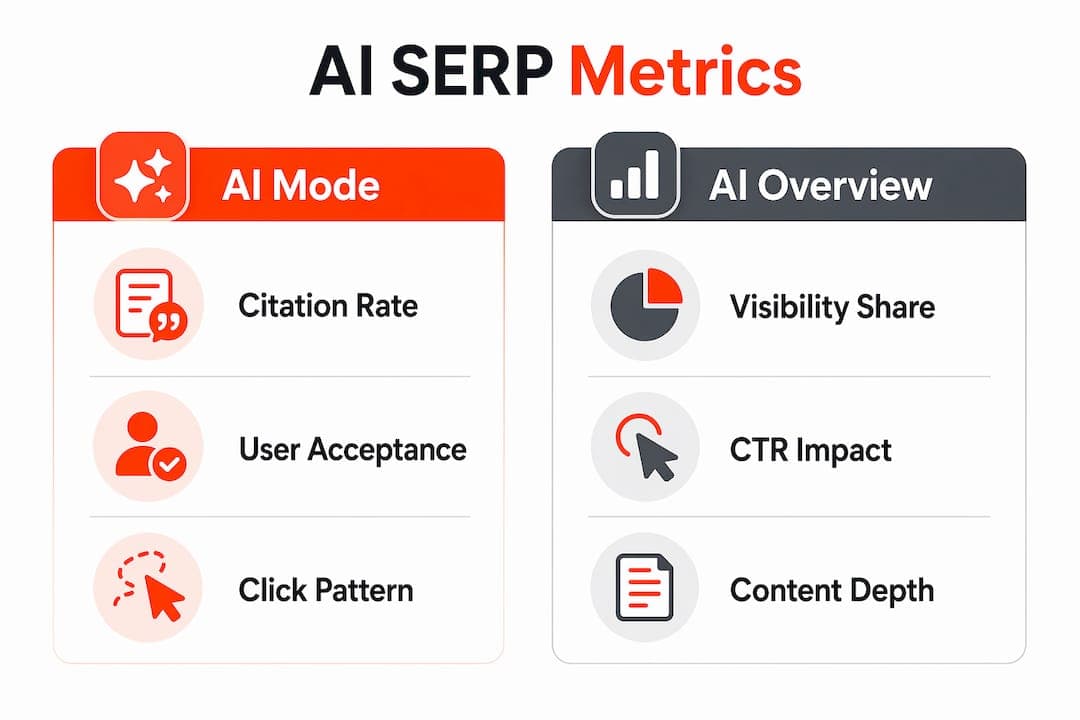
| Feature | User Behavior | Primary KPI | Click Pattern |
|---|---|---|---|
| AI Mode | Accepts shortlist with 88% rate, low reconsideration | Shortlist citation rate | Fewer, more decisive clicks |
| AI Overview | Extensive scroll reversal, multi-source comparison | Citation share + organic rank | More browsing before click |
| Traditional organic | Direct intent matching, query-result comparison | Position, CTR, impressions | Intent-driven click patterns |
One particularly counterintuitive finding: cursor and scroll data reveal time-on-page similarity across navigational, informational, and transactional queries within AI Overview SERPs. The traditional intent segmentation that drove your content architecture may be less predictive than it used to be.
For practical segmentation, prioritize your keyword portfolio by AI Overview trigger rate. Queries in high-trigger industries like education, healthcare, and B2B technology demand immediate citation tracking. Queries with strong local intent or very short tail show lower trigger rates and respond better to conventional ranking tactics. The role of machine learning in SEO is clearest here. Platforms that can automatically segment your keyword set by feature trigger probability save hours of manual classification every week.
Practical strategies to win in the AI SERP era
Knowing the theory is not enough. Here is what actually moves the needle when you implement AI and keyword ranking strategies alongside AI Overview citation optimization:
- Build for citation depth, not just ranking position. AI Overviews cite pages with comprehensive coverage, clear structure, and verified author credentials. A page ranking number four with strong topical depth can earn more AI citations than the page ranking number one with thin content.
- Audit technical fundamentals first. Crawlability and page speed are not legacy concerns. They directly influence whether AI indexing systems can access and process your content. Google's optimization guidance continues to treat these as the primary levers.
- Integrate citation tracking into your analytics stack. Set up a parallel reporting layer that tracks AI Overview citation frequency alongside traditional rank and CTR data. Without this, you cannot attribute revenue changes to SERP feature shifts versus organic ranking movements.
- Adjust paid search bidding in high AI Overview verticals. If your industry shows high AI Overview trigger rates, impression volume staying stable while CTR drops is a signal that your cost-per-click strategy needs recalibration. Shift budget toward branded terms and lower-funnel queries where AI Overviews appear less frequently.
- Produce genuinely differentiated content. Generic topic coverage gets synthesized away into the AI Overview without a citation. Original data, specific expert perspectives, and proprietary frameworks give AI systems a reason to cite your page as a unique source rather than paraphrase it without attribution.
Pro Tip: When auditing your content strategy for AI search, run your top 20 pages through a citation gap check. Compare which pages earn AI Overview citations versus which rank well organically. The mismatch reveals exactly where content depth improvements will deliver dual returns.
My honest take on navigating AI-augmented SERPs
I've watched SEO teams get distracted chasing AI-specific tricks since the moment AI Overviews started appearing at scale. The pattern is familiar: a new feature launches, speculation floods the industry, and practitioners start adding workarounds that solve nothing while burning hours. My experience with automating SERP analysis with AI has shown me something more boring but more useful. The teams outperforming their competitors right now are not doing anything exotic. They are doing core SEO better than everyone else, and they are measuring more precisely.
What shifted for me personally was treating AI citation share as a real metric with revenue implications, not just a novelty to monitor. When I started correlating citation appearances with actual traffic and conversion data, the relationship became undeniable. Pages that earned citations held traffic levels even when their organic rank slipped during algorithm updates.
The second shift was accepting that structured SERP data is the only reliable input for any AI reasoning layer. I stopped trusting analysis from tools that could not show me their retrieval source. If a platform tells you your competitor ranks third for a high-volume term but cannot show you the live SERP that produced that conclusion, the insight is not worth acting on.
My overall read: the role of machine learning in SEO is not to replace your judgment. It is to surface the patterns that make your judgment more accurate, faster. Teams that understand this distinction are building durable advantages. Teams still looking for AI shortcuts are falling further behind every quarter.
— MEET
How Babylovegrowth accelerates your SERP analysis
If the strategies above describe where you want to be but the tooling gap is holding you back, Babylovegrowth was built for exactly this problem.
Babylovegrowth gives SEO professionals and digital marketing teams the infrastructure to execute AI-driven analysis at scale. The platform's keyword discovery tools identify untapped opportunities by analyzing real-time SERP data, not static databases. The AI SEO audit evaluates your site's readiness for AI-featured placements, checking content depth, structured data, crawlability, and technical performance in one pass. For teams ready to close citation gaps and build AI-era organic visibility, Babylovegrowth provides the daily content infrastructure, internal linking automation, and competitive tracking that turns strategy into consistent execution. Explore what the platform can do for your search presence and start with a free audit today.
FAQ
What is the role of AI in SERP analysis?
AI in SERP analysis goes beyond data collection. It processes structured search results to identify ranking patterns, predict AI feature triggers, and surface competitive gaps that manual workflows cannot detect reliably.
How do AI Overviews affect organic rankings?
AI Overviews push organic listings and paid ads further down the page. Pages with strong content depth and authoritative signals can earn citations inside these overviews regardless of their traditional organic rank.
Do I need special markup to appear in AI-generated search features?
No. Google states that no special AI schema or content restructuring is required. Standard SEO best practices covering quality content, crawlability, and structured data are sufficient.
How is AI Mode different from AI Overviews for SEO measurement?
AI Mode produces a closed shortlist that users accept at an 88% rate, requiring citation rate as the primary KPI. AI Overviews drive more browsing behavior, making citation share combined with organic rank the more relevant measurement framework.
Which industries are most affected by AI Overviews?
Education and B2B technology show the highest AI Overview trigger rates, while local intent queries show lower rates. Industry-specific trigger rate segmentation should drive how you prioritize content and citation optimization efforts.