Why personalized content matters: boost engagement and results


TL;DR:
- Personalized content is essential for driving engagement, conversions, and brand loyalty in modern digital marketing.
- AI-powered personalization automates real-time, context-aware messaging across channels, enhancing results and reducing costs.
You pour budget into content, watch it go live, and wait. Then the analytics come back flat: mediocre click-through rates, low time on page, and conversions that barely budge. The problem usually isn't the writing or the channel. It's that the message wasn't built for anyone specific. Consumers now expect personalization as a baseline, and when brands don't deliver it, frustration follows fast. This guide breaks down exactly why personalized content has become the most powerful lever in your marketing stack and how to use it to drive real, measurable results.
Table of Contents
- Why personalized content breaks through digital noise
- Proven impact: Engagement, conversions, and revenue gains
- The AI-driven personalization edge: How it works in practice
- Personalization for organic traffic: Navigating AI-driven search landscapes
- Personalization beyond the website: The email and channel effect
- The hard truth: Personalization is not just a tech upgrade—it's a strategy shift
- Next steps: Supercharge your content personalization with AI tools
- Frequently asked questions
Key Takeaways
| Point | Details |
|---|---|
| Personalization drives results | Tailoring content raises engagement, loyalty, and business performance. |
| AI enables scalable impact | Automating content delivery with AI allows marketers to personalize at scale and in real time. |
| Beyond clicks: measure deeper | Focus on user journeys and deeper engagement metrics to sustain organic growth in an AI-transformed search world. |
| Continuous testing is vital | Success comes from iteratively experimenting and refining your personalization strategies. |
| Channel-wide optimization | Apply personalization across website, email, and every touchpoint to maximize growth opportunities. |
Why personalized content breaks through digital noise
With expectations rising, let's clarify why personalized content makes such a dramatic difference compared to traditional approaches.
Generic content has a fundamental problem: it speaks to everyone and resonates with no one. When a prospect lands on your site after searching for a specific solution and finds a broad overview that could apply to any business in any industry, they bounce. The message didn't match their context, their pain point, or where they are in the buying journey. That's a wasted impression.
Personalized content transforms generic touchpoints into relevant exchanges that speak directly to a user's situation, increasing both engagement and loyalty while helping marketers convert the same traffic far more effectively. Think of it as the difference between a TV commercial playing to millions and a conversation tailored to one person's exact needs."Consumers have moved from treating personalization as optional to expecting it; many feel frustrated when it does not happen." — Contentful, Dynamic Personalization: Meeting Customers Where They Are
The numbers back this up. Over 70% of customers expect personalization from the brands they interact with, and 75% report frustration when experiences feel one-size-fits-all. That frustration directly translates to churn, lower lifetime value, and lost revenue.
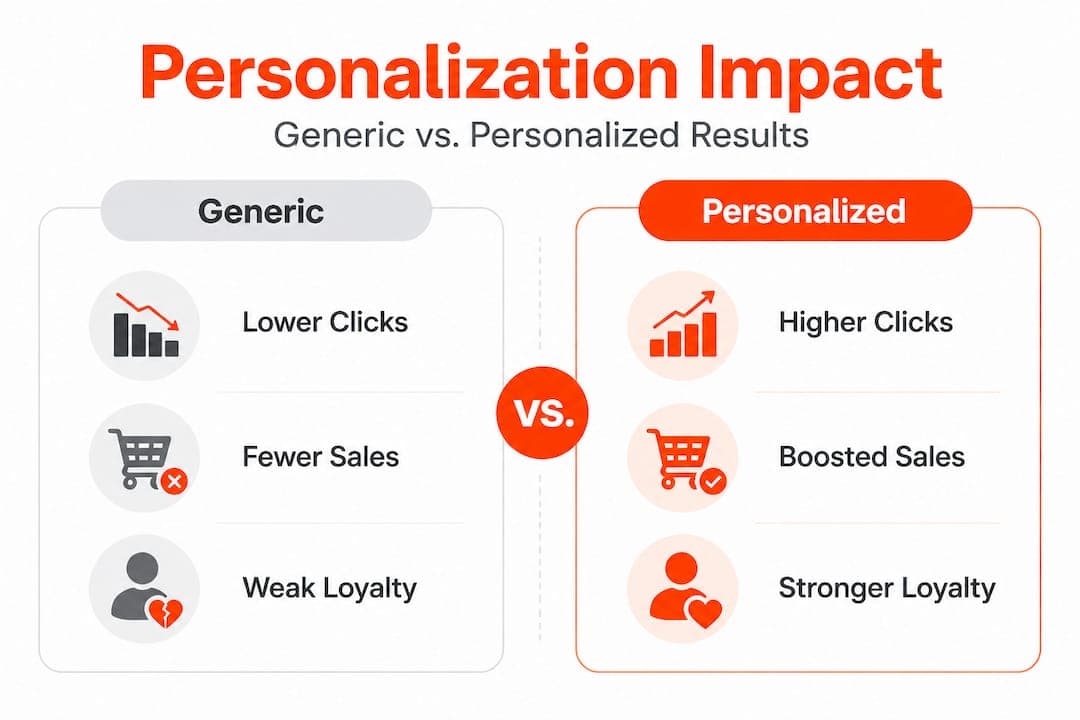
Here's a quick comparison of how generic versus personalized content performs across key metrics:
| Metric | Generic content | Personalized content |
|---|---|---|
| Click-through rate | Low to average | Significantly higher |
| Conversion rate | 1 to 3% typical | Up to 5 to 8%+ |
| Email open rate | Industry average | 20 to 40% lift |
| Customer loyalty | Moderate | Substantially stronger |
| Time on page | Short | Longer, deeper engagement |
What drives brand loyalty isn't just good products. It's the feeling that a brand actually understands you. When your content reflects a user's context, industry, or stage in the funnel, it builds trust. And trust is what converts browsers into buyers and buyers into repeat customers. You can explore brand visibility case studies to see how content relevance translates directly into sustained traffic and pipeline growth.
Key reasons personalized content outperforms generic messaging:
- It matches the user's intent and mindset at the moment of engagement
- It reduces cognitive load by filtering out irrelevant information
- It signals that your brand pays attention and cares about the individual
- It creates emotional resonance, which drives action far better than logic alone
- It builds a feedback loop where better data leads to even more relevant content
Proven impact: Engagement, conversions, and revenue gains
Now that you understand the audience expectation and potential for loyalty, let's quantify how personalization drives measurable lifts for your business.
Data doesn't lie. Businesses that invest in intelligent, dynamic personalization aren't just seeing marginal improvements. They're seeing transformative gains that reshape their entire marketing ROI.
Take Ruggable as a real-world example. By implementing real-time personalization strategies based on incoming traffic type and account characteristics, they achieved a 7x higher click-through rate and a 25% increase in conversion rate. That's not a minor optimization. That's a fundamentally different business outcome from the same traffic volume.

The Salesforce Einstein AI case study tells a similar story. When subscribers were sent identical, non-personalized emails, engagement flatlined. After implementing personalized content and AI-driven recommendations, the results were striking: a 40% increase in email open rates, a 20% lift in click-through rates, and a 15% increase in revenue directly attributed to email. Same list. Completely different results.
McKinsey research shows that adopting a "next best experience" approach powered by AI can boost customer satisfaction by up to 20% while cutting operational costs by as much as 30%. That dual benefit, better outcomes at lower cost, is the business case that makes personalization a strategic priority rather than a nice-to-have.
Key results from leading personalization implementations:
- Ruggable: 7x CTR increase and 25% higher conversions from real-time, traffic-aware personalization
- Salesforce Einstein users: 40% open rate lift, 20% CTR improvement, 15% email revenue increase
- McKinsey "next best experience" programs: up to 20% customer satisfaction gain and 30% cost reduction
- AI-driven recommendation engines: double-digit lifts in open rates, click rates, and downstream revenue
Pro Tip: Don't treat personalization as a single campaign. Set up ongoing A/B tests that compare personalized versus non-personalized variants across your highest-traffic pages and email sequences. Even small, incremental wins compound quickly when you're iterating weekly.
The core insight from all these data points is that personalization works best when it's treated as a measurement and decisioning system rather than just a set of content blocks. Static personalization (showing a different hero image based on referral source) is a starting point, not a strategy. Intelligent systems that learn from behavior and adjust dynamically are where the real gains live.
You can connect the dots between data-driven personalization and broader AI marketing strategies to understand how these tactics fit into a cohesive growth plan.
The AI-driven personalization edge: How it works in practice
With evidence of performance gains, the next step is understanding how AI-powered personalization actually works in real-world marketing workflows.
Scaling personalization manually is impossible. You can't write a unique landing page for every visitor segment, send individually timed emails to a list of 50,000, or dynamically adjust homepage content for every traffic source without automation. This is precisely where AI earns its place in your marketing stack.
AI-powered personalization workflows use audience segments, experimentation and A/B tests, and content sources integrated into a CMS to deliver the right content to the right person at exactly the right moment. The architecture typically involves several interconnected components:- Data collection and audience segmentation: AI gathers behavioral, demographic, and contextual signals, then groups users into meaningful segments based on shared characteristics or lifecycle stage
- Dynamic content assembly: Instead of static pages, the system pulls content modules appropriate for each segment and assembles them in real time
- Lifecycle targeting: Different messages go to new visitors, returning users, trial users, and long-term customers because each group needs something entirely different
- Experimentation and A/B testing: The system continuously tests content variants and automatically shifts traffic toward better-performing versions
- CMS integration: All of this is managed through a central content management system that syncs with your personalization engine and analytics stack
Generic or limited segmentation consistently stalls engagement until actual intelligence and context-awareness are added. The brands that see the biggest results aren't using basic demographic splits. They're leveraging behavioral signals, traffic source data, account-level characteristics for B2B, and real-time lifecycle context.
Pro Tip: Start with three to five clearly defined audience segments before adding more complexity. Getting segmentation right is more important than having dozens of poorly defined groups. Precision beats volume every time.
Key capabilities you need in your AI personalization stack:
- Real-time behavior tracking and signal processing
- Dynamic content rendering based on user context
- Automated A/B and multivariate testing
- Integration with your CRM and email platform
- Reporting that links content variants to revenue outcomes
For a deeper look at how this connects to organic growth, see how AI content strategy drives SEO performance and how AI-driven content creation scales these workflows efficiently.
Personalization for organic traffic: Navigating AI-driven search landscapes
Once you've set up effective AI-powered personalization, you need to know why it matters for organic search and brand visibility in 2026's evolving digital ecosystem.
Here's the uncomfortable reality: AI-driven search is changing the rules. Chatbots like ChatGPT, Claude, and Perplexity are giving users direct answers without requiring them to click through to your website. Zero-click search results are increasing across Google too. Traditional organic traffic metrics are under pressure, and for many brands, click-through rates from search are declining even when rankings hold steady.
This shift makes on-site personalization even more critical. When a visitor does arrive, you have one shot to make the experience so relevant, so clearly useful, and so engaging that they stay, explore, and convert. Generic content wastes that shot completely.
Personalization supports organic performance in several key ways:
- Longer session duration signals to search engines that your content satisfies user intent
- Lower bounce rates indicate that the experience matched what visitors were looking for
- Higher return visit rates build the authority signals that search algorithms reward
- Engagement-driven conversions preserve business value even as raw traffic numbers shift
- Brand recall increases when users have a personalized, memorable experience, driving direct traffic over time
The marketers who will win in this new landscape are the ones who shift their mindset from "how do I get more clicks from search" to "how do I make every visit count." Personalization is the engine that makes every visit more valuable. Check out our guidance on optimizing for AI search and AI content optimization to stay ahead of these shifts.
Personalization beyond the website: The email and channel effect
Beyond your own site and search, let's examine how AI-driven personalized content fuels engagement and revenue growth across key marketing channels like email.
Your website is just one touchpoint. Real personalization strategy extends across every channel where your audience shows up, and email remains one of the highest-ROI channels available to digital marketers when it's done right.
AI-powered email personalization does far more than insert a first name in the subject line. It optimizes content relevance and send timing to maximize opens and downstream engagement, which directly supports revenue outcomes. Send-time optimization alone can increase open rates by up to 22%, simply by learning when each individual subscriber is most likely to engage and delivering the message at that exact moment.
When you stack multiple personalization factors together, the compounding effect is significant. AI can simultaneously optimize:
- Subject line and preview text based on what language resonates with each segment
- Content body and offers matched to the subscriber's purchase history or browsing behavior
- Call-to-action placement and wording tailored to where the subscriber is in the funnel
- Send timing individualized to each recipient's engagement history
- Frequency and cadence adjusted to avoid list fatigue while maximizing touchpoints
Pro Tip: Use behavioral triggers rather than calendar-based email sequences. An email sent because a user visited your pricing page three times in a week will always outperform a scheduled weekly newsletter going to your entire list. Behavior-based triggers show up when intent is highest.
Applying personalization across channels, including email, social retargeting, push notifications, and on-site messaging, creates a cohesive experience that reinforces your brand message without feeling repetitive. Explore how scaling AI content marketing can unify these channels under a single intelligent strategy.
The hard truth: Personalization is not just a tech upgrade—it's a strategy shift
Wrapping up the how-to, let's step back for a candid look at what separates real personalized content strategy success from superficial efforts.
We see it constantly. A marketing team installs a personalization tool, sets up three audience segments based on job title, and declares victory. Six months later, results are underwhelming and the tool gets blamed. The technology isn't the problem. The strategy is.
Effective personalization is real-time, context-aware, and paired with continuous experimentation. It accounts for traffic source, account-level signals, lifecycle stage, and behavioral context. And it treats every deployment as a hypothesis to be tested, not a solution to be installed.
The brands that get lasting results from personalization share a few common traits: they treat it as an ongoing discipline rather than a one-time project, they invest in understanding their audience at a granular level before layering in automation, and they give their teams the freedom to experiment and iterate quickly.
The uncomfortable truth is that most personalization failures are strategy failures, not technology failures. The tools exist. The data is available. What's missing is the organizational commitment to treat personalization as a core competency, not a quarterly initiative.
Building that competency requires combining agile testing processes, deep audience research, human creative judgment, and AI tools that learn and adapt. None of those elements alone is enough. Together, they create the kind of AI-driven brand building that compounds over time and becomes genuinely difficult for competitors to replicate.
Next steps: Supercharge your content personalization with AI tools
If you're ready to move from theory to action, here are practical steps and tools to jump-start your personalized content and growth journey.
Babylovegrowth.ai is built specifically for digital marketers and business owners who need AI-driven personalization at scale without assembling a complex tech stack from scratch. The platform combines intelligent AI keyword discovery with automated content planning, daily SEO articles, and structured data markup so your personalized content is always optimized for both human readers and AI-driven search engines.
From AI keyword research that identifies exactly what your audience is searching for to a full AI content marketing platform that publishes, links, and tracks performance automatically, Babylovegrowth.ai gives you the infrastructure to deliver personalized content experiences at scale. Stop guessing what your audience wants and start building content that finds them, engages them, and converts them with every interaction.
Frequently asked questions
What is personalized content in digital marketing?
Personalized content tailors messages, offers, or experiences for individual users based on their preferences, context, or behavior, turning generic messaging into relevant exchanges that increase engagement and drive loyalty.
How does AI enable better personalization for marketers?
AI automates customer data analysis and predicts what content will resonate, enabling real-time dynamic personalization at scale through structured workflows that integrate audience segments, A/B tests, and CMS-connected content sources.
Does personalizing content help organic search performance?
Yes, personalization increases on-site engagement and loyalty signals that search engines reward, and it helps offset the traffic decline caused by AI-driven zero-click search environments by making every visit more valuable.
What metrics prove that personalized content is effective?
Track click-through rates, conversion rates, email open rates, and customer satisfaction scores. Real-world benchmarks like Ruggable's 7x CTR lift and Salesforce Einstein's 40% open rate increase give you realistic targets to aim for.
Is personalization only for websites, or should it extend to emails and other channels?
Personalization is most powerful when applied across all digital channels. AI timing and relevance optimization in email alone can lift open rates by up to 22%, and the compounding effect across channels dramatically amplifies total marketing performance.