Role of AI in Marketing Strategies: Driving Results


Every agency leader knows the challenge of adapting client strategies to growing data demands and shifting algorithms. The rapid rise of Artificial Intelligence in marketing is now unlocking unprecedented levels of marketing intelligence, helping agencies personalize campaigns and target audiences more precisely than ever. As research confirms, AI is not just a passing trend but a critical tool that drives competitive advantage and innovation within complex digital environments. Discover how intelligent technologies can transform your approach to organic visibility and lead generation.
Table of Contents
- Defining AI's Role In Modern Marketing
- Types Of AI Tools Shaping Strategies
- How AI Transforms SEO And Content
- Personalization, Automation, And Analytics Impact
- Challenges, Risks, And Common Pitfalls
- Future Trends In AI-Driven Marketing
Key Takeaways
| Point | Details |
|---|---|
| AI Transforms Marketing | AI enhances marketing strategies by offering data-driven insights and personalization. |
| Emphasize Personalization | Utilizing AI allows businesses to craft individualized customer experiences and optimize engagement. |
| Address Ethical Challenges | Companies must establish ethical frameworks to manage data privacy, bias, and consumer trust in AI applications. |
| Invest in Continuous Learning | Staying updated on AI trends is essential for marketers to leverage technological advancements effectively. |
Defining AI's Role in Modern Marketing
Artificial Intelligence (AI) is fundamentally reshaping how businesses approach marketing strategies, transforming traditional methodologies into dynamic, data-driven processes. Marketing intelligence now leverages advanced algorithmic capabilities to deliver unprecedented insights and personalization.
Research indicates that AI is not merely a technological trend but a critical competitive advantage. Comprehensive marketing transformation studies demonstrate AI's potential to revolutionize marketing across multiple domains, enabling businesses to innovate and adapt in increasingly complex environments.
Key dimensions of AI's marketing impact include:
- Predictive Analytics: Anticipating customer behaviors and preferences
- Personalization Engines: Crafting individualized customer experiences
- Automated Campaign Optimization: Real-time performance adjustments
- Intelligent Customer Segmentation: Precise audience targeting
The digital marketing landscape now recognizes AI as a fundamental tool for understanding and engaging customers. Marketing effectiveness research reveals that AI-powered technologies dramatically enhance campaign performance through advanced recommendation systems, intelligent chatbots, and sophisticated predictive modeling.
Pro tip: Start integrating AI incrementally by identifying one specific marketing process where algorithmic insights could provide immediate measurable improvements.
Types of AI Tools Shaping Strategies
AI tools are rapidly transforming marketing strategies by providing sophisticated technological solutions that enable businesses to process vast amounts of data and generate actionable insights. Advanced marketing technologies now encompass a wide range of intelligent systems designed to optimize marketing performance across multiple dimensions.
The primary categories of AI marketing tools include:
- Predictive Analytics Tools: Forecasting customer behaviors and market trends
- Customer Segmentation Platforms: Creating precise audience profiles
- Personalization Engines: Tailoring content and recommendations
- Automated Marketing Assistants: Managing campaign workflows
- Sentiment Analysis Systems: Evaluating brand perception and customer feedback
Machine learning technologies are particularly powerful in marketing contexts. Comprehensive AI technology research reveals how neural networks and deep learning algorithms can process complex data volumes, generating sophisticated market intelligence that transforms traditional marketing approaches.
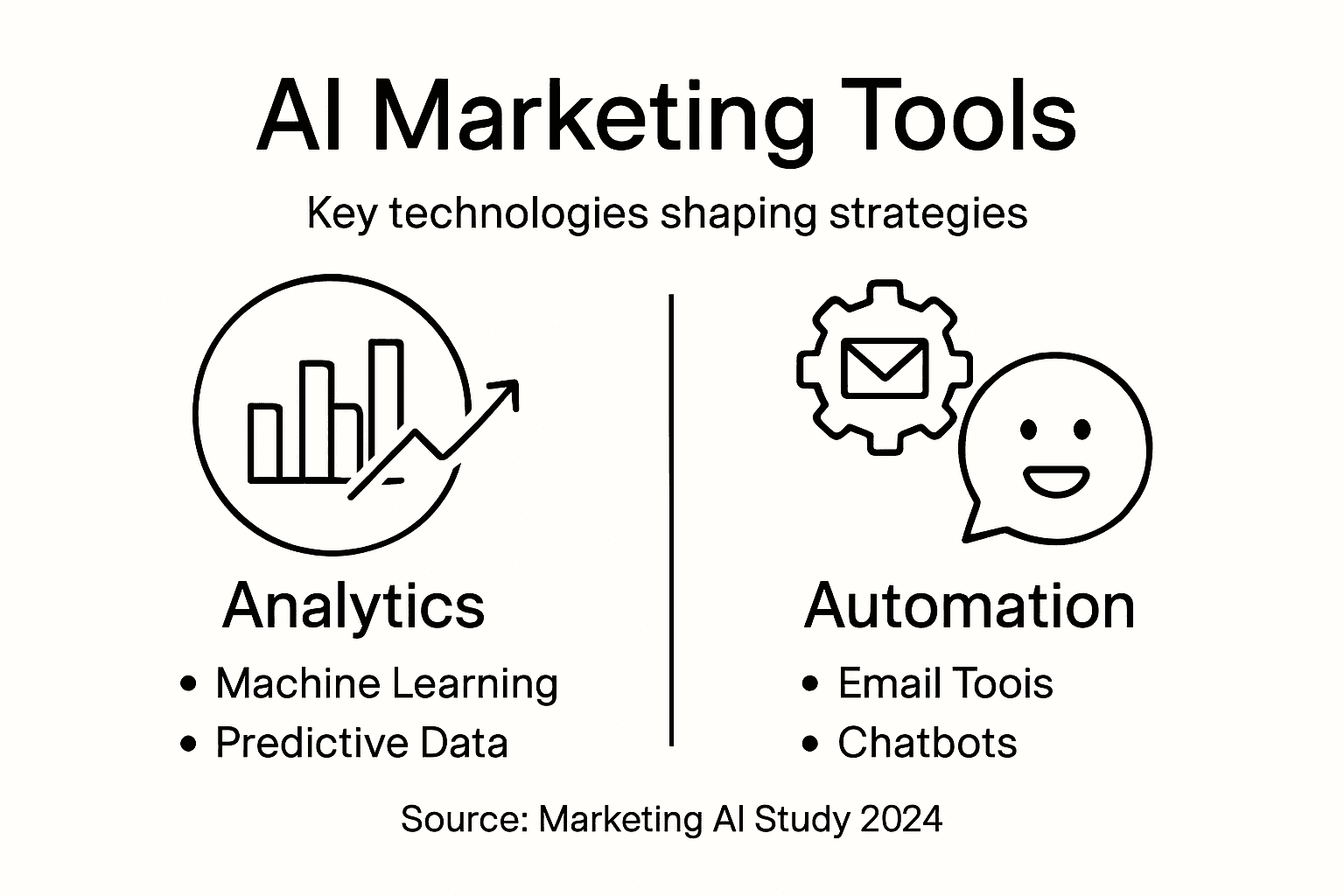
These AI tools enable marketers to move beyond generic strategies, creating hyper-targeted campaigns that respond dynamically to customer interactions and preferences. By leveraging intelligent algorithms, businesses can achieve unprecedented levels of customer engagement and strategic precision.
Pro tip: Select an AI marketing tool that aligns with your most critical performance metric and start with a small-scale pilot to demonstrate measurable impact.
Here's a summary comparing major AI tool categories in marketing:
| AI Tool Category | Primary Function | Business Value |
|---|---|---|
| Predictive Analytics | Forecasts customer trends | Anticipates market changes |
| Personalization Engines | Tailors content delivery | Boosts engagement rates |
| Automation Platforms | Streamlines workflows | Saves operational time |
| Sentiment Analysis | Assesses brand perception | Guides brand positioning |
| Segmentation Platforms | Builds audience profiles | Improves targeting accuracy |
How AI Transforms SEO and Content
AI is revolutionizing search engine optimization and content creation by introducing unprecedented levels of precision, personalization, and efficiency. Advanced content generation techniques are enabling marketers to develop more targeted and intelligent content strategies that adapt dynamically to user behaviors and search engine algorithms.
Key transformative capabilities of AI in SEO and content include:
- Intelligent Keyword Analysis: Identifying high-potential search terms
- Content Optimization: Automatically improving readability and relevance
- Semantic Understanding: Generating contextually appropriate content
- Predictive Performance Modeling: Forecasting content effectiveness
- Real-time Content Adaptation: Adjusting strategies based on user engagement
The emergence of natural language processing has dramatically expanded AI's capabilities in content creation. Digital marketing AI technologies now enable sophisticated communication tools that can generate human-like content, personalize user experiences, and optimize search engine rankings with remarkable accuracy.
By leveraging AI, marketers can transcend traditional content limitations, creating more responsive, intelligent, and targeted communication strategies that align precisely with audience expectations and search engine requirements.
Pro tip: Implement AI content tools incrementally, starting with specific high-impact areas like keyword research or content optimization to validate their effectiveness.
Personalization, Automation, and Analytics Impact
AI is fundamentally reshaping marketing through sophisticated approaches to personalization, automation, and data-driven analytics. Advanced marketing capabilities are enabling businesses to transform customer interactions by leveraging intelligent technologies that analyze complex behavioral patterns and generate predictive insights.
The core transformative elements of AI-driven marketing include:
- Dynamic Personalization: Crafting individualized customer experiences
- Predictive Customer Segmentation: Identifying precise audience targeting opportunities
- Real-time Performance Analytics: Measuring campaign effectiveness instantly
- Automated Workflow Optimization: Streamlining marketing processes
- Intelligent Content Recommendations: Tailoring messaging to individual preferences
Marketing automation has reached unprecedented levels of sophistication. AI-powered marketing communication now enables businesses to create highly targeted, contextually relevant interactions that adapt dynamically to individual customer behaviors and preferences, dramatically improving engagement and conversion rates.

By integrating advanced AI technologies, marketers can transcend traditional limitations, creating more responsive, intelligent strategies that align precisely with evolving customer expectations and deliver measurable business outcomes.
Pro tip: Start implementing AI-driven personalization by focusing on one specific customer touchpoint and gradually expanding your approach based on measurable results.
Challenges, Risks, and Common Pitfalls
Integrating AI into marketing strategies presents complex challenges that require careful navigation and strategic consideration. Ethical considerations in AI marketing reveal significant consumer skepticism and potential risks that can undermine technological investments if not addressed proactively.
Critical challenges in AI marketing adoption include:
- Data Privacy Concerns: Managing sensitive customer information
- Algorithmic Bias: Preventing skewed decision-making processes
- Consumer Trust: Maintaining transparency in AI-driven interactions
- Technological Complexity: Managing sophisticated AI implementation
- Ethical Decision Making: Ensuring responsible AI usage
Algorithmic limitations represent a significant potential pitfall for marketers. AI adoption research highlights critical risks such as over-reliance on automation, potential biases in machine learning models, and the substantial challenge of maintaining genuine human connection in increasingly algorithmic interactions.
Successful AI integration demands a nuanced approach that balances technological capability with human oversight, ensuring that AI tools enhance rather than replace strategic human decision-making. Marketers must remain vigilant about potential blind spots and continuously audit AI systems for accuracy, fairness, and alignment with broader organizational goals.
Pro tip: Develop a robust AI governance framework that includes regular algorithmic audits, diverse training data, and clear ethical guidelines to mitigate potential risks and maintain consumer trust.
To clarify potential issues, here's a comparison of common AI marketing challenges and mitigation strategies:
| Challenge | Business Impact | Mitigation Strategy |
|---|---|---|
| Data Privacy | Risk of regulatory penalties | Use robust encryption practices |
| Algorithmic Bias | Skewed targeting outcomes | Diversify training data sources |
| Consumer Trust | Reduced brand loyalty | Communicate AI transparency |
| Tech Complexity | Implementation delays | Invest in staff training |
| Ethical Decision Making | Reputational damage | Establish ethical review committees |
Future Trends in AI-Driven Marketing
The landscape of marketing is poised for transformative changes driven by advancing AI technologies that promise to redefine customer engagement and strategic planning. Emerging marketing technology trends indicate a future where artificial intelligence becomes increasingly sophisticated in generating predictive insights and creating highly personalized consumer experiences.
Key anticipated developments in AI-driven marketing include:
- Generative AI Content Creation: Producing dynamic, contextually relevant materials
- Hyper-Personalization Engines: Delivering individualized customer experiences
- Advanced Predictive Analytics: Forecasting consumer behaviors with unprecedented accuracy
- Ethical AI Governance: Establishing robust frameworks for responsible technology use
- Real-time Adaptive Marketing: Creating responsive, intelligent campaign strategies
Emerging technologies are set to revolutionize marketing approaches. Digital marketing AI innovations suggest a future where complex decision-making processes become increasingly automated, while maintaining critical human oversight to ensure authenticity and ethical implementation.
Marketers who successfully navigate these technological shifts will transform their strategies from reactive to proactively predictive, leveraging AI as a collaborative tool that enhances human creativity and strategic thinking rather than replacing it entirely.
Pro tip: Invest in continuous learning and adaptable AI integration strategies that prioritize ethical considerations and maintain a human-centric approach to technological innovation.
Unlock AI-Driven Marketing Success with Babylovegrowth.ai
The article highlights key challenges businesses face when integrating AI into marketing, such as automation complexity, personalization demands, and maintaining strong SEO in a competitive digital landscape. If you are striving to harness AI for predictive analytics, content optimization, and personalization but struggle with managing technical SEO or generating consistent, high-quality content, you are not alone. Babylovegrowth.ai addresses these exact pain points by providing an all-in-one SaaS platform tailored for brands aiming to boost organic traffic through AI-powered SEO and content strategies.
Babylovegrowth.ai automates keyword discovery, publishing, backlink building, and comprehensive website auditing to keep your marketing efforts aligned with the latest search engine and AI-driven platform requirements. This means you can focus on growing your brand while our platform ensures your site ranks higher and engages the right audience effectively.
Ready to transform your marketing strategy with intelligent automation and precise SEO? Discover how easy it is to start driving measurable growth by visiting Babylovegrowth.ai
Leverage the power of AI for your SEO and content needs now. Visit Babylovegrowth.ai and explore automated keyword tools and dynamic content planning that seamlessly fit into your marketing strategy. Don’t let complexity hold you back when scalable growth is just a click away.
Frequently Asked Questions
What is the role of AI in modern marketing strategies?
AI plays a critical role in modern marketing strategies by transforming traditional methodologies into dynamic, data-driven processes, enabling businesses to gain insights, enhance personalization, and automate campaign management.
How can AI improve customer personalization in marketing?
AI improves customer personalization through advanced algorithms that analyze individual behaviors and preferences, allowing businesses to craft tailored experiences that resonate with specific audience segments.
What are some common AI tools used in marketing?
Common AI tools in marketing include predictive analytics tools, customer segmentation platforms, personalization engines, automated marketing assistants, and sentiment analysis systems, which help enhance campaign effectiveness and customer engagement.
What challenges do businesses face when integrating AI into their marketing strategies?
Businesses face challenges such as data privacy concerns, algorithmic bias, maintaining consumer trust, managing the complexity of AI technologies, and ensuring ethical decision-making when integrating AI into their marketing strategies.