Backlink Diversity in SaaS SEO: 2026 Strategy Guide


TL;DR:
- Backlink diversity involves acquiring links from a broad range of authoritative, relevant sources to enhance SaaS SEO performance. Google evaluates the overall link profile, prioritizing unique domains, topical relevance, and authority distribution over raw link counts, making strategic diversity essential for ranking success. Maintaining a balanced, natural profile through consistent, relevant outreach and internal linking is key to sustainable growth and avoiding penalties.
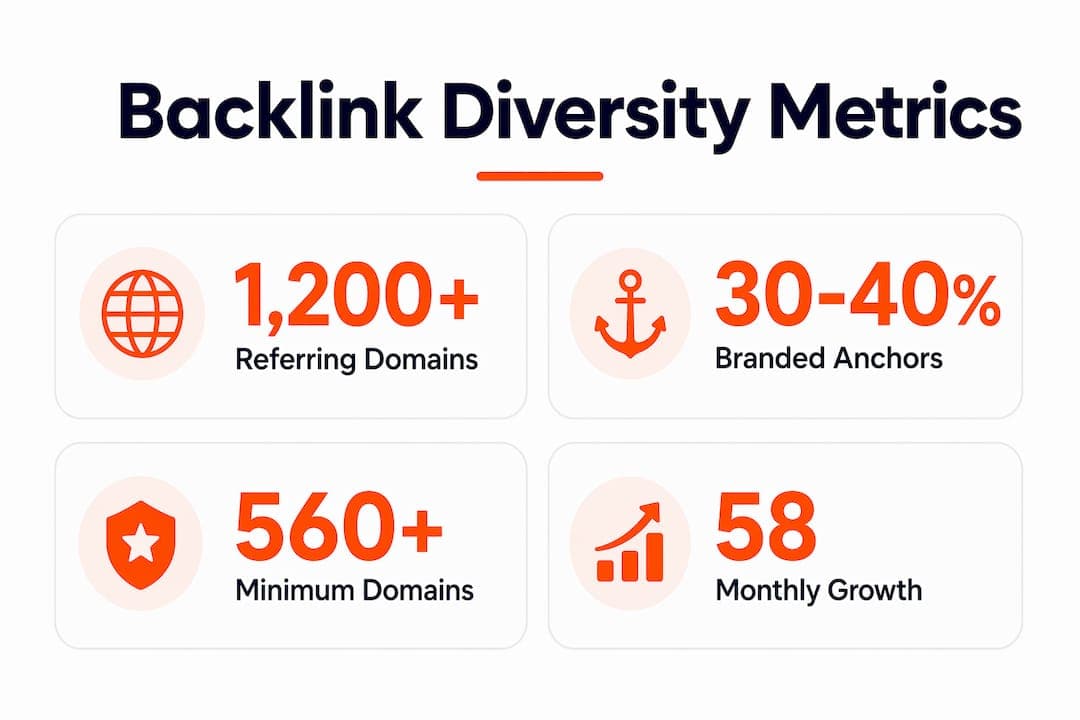
Backlink diversity is the practice of acquiring links from a wide variety of unique, authoritative, and topically relevant sources to strengthen SaaS SEO performance. The role of backlink diversity in SaaS SEO goes far beyond collecting links. Google evaluates the breadth, context, and authority distribution of your entire link profile, not just raw link counts. Page-one SaaS sites carry a median of 1,200 referring domains, with a competitive floor at 560 and an average monthly acquisition velocity of 58 new domains. That benchmark tells you exactly what you are competing against. Tools like Ahrefs and SEMrush make it possible to audit your current profile against these numbers and identify where your diversity gaps are costing you rankings.
How backlink diversity impacts SaaS search rankings
Google does not count links. It weighs them. A hundred links from ten domains carry far less authority signal than a hundred links from a hundred distinct domains. For SaaS companies competing in crowded categories like project management, CRM, or cybersecurity, this distinction determines whether you rank on page one or page three.
Google's SpamBrain penalizes unnatural link patterns, which means any profile that concentrates links from a narrow set of sources or shows sudden acquisition spikes triggers algorithmic scrutiny. Earned, contextual links from varied sources are what build the natural diversity that reduces this risk. The practical implication is that a SaaS company buying 50 links from the same link farm is not just wasting money. It is actively building a liability.The data on editorial link quality reinforces this point sharply. Editorial links make up 92.2% of backlinks across page-one ranking domains, while directory and resource page links account for less than 8%. This means the overwhelming majority of ranking power comes from links placed naturally within content by real publishers. For SaaS marketers, this shifts the strategy away from directory submissions and toward PR, thought leadership, and integration partnerships.
Backlink diversity also signals topical authority. When your SaaS product earns links from HR publications, productivity blogs, enterprise tech media, and developer forums simultaneously, Google interprets that as multi-dimensional relevance. A single-source profile, even from a high-authority domain, signals a narrow footprint. The goal is coverage across your topic cluster, not depth from one source.
Key signals Google reads from a diverse backlink profile:
- Referring domain count: Unique domains matter more than total link count
- Authority distribution: A mix of DR 40 to DR 85 sources looks natural; only DR 80+ looks purchased
- Topical spread: Links from multiple verticals relevant to your SaaS category
- Anchor text variation: Branded, generic, and partial-match anchors in natural ratios
- Link placement: In-body editorial links outperform footer or sidebar placements
Building a naturally diverse backlink profile for SaaS
The most practical framework for SaaS backlink diversity targets a specific portfolio mix. A balanced SaaS backlink portfolio allocates roughly 20 to 30% of links to high-authority sources at DR 70 or above, with the remaining 70 to 80% concentrated in the DR 40 to 70 mid-tier range focused on topical relevance. This distribution looks natural to Google and delivers compounding authority over time.

The reason mid-tier links dominate the ideal mix is counterintuitive to many SaaS marketers. A DR 55 link on a niche-relevant, buyer-popular publication can drive more real SEO and business results than a DR 85 link on a generic platform. Context beats raw authority. A link from a SaaS-focused review site at DR 52 is worth more to your rankings than a link from a general news aggregator at DR 80 that has no topical connection to your product.
Comparing link types for SaaS backlink strategy
| Link type | Authority tier | Topical relevance | Acquisition method |
|---|---|---|---|
| Guest post on SaaS publication | DR 50–75 | High | Outreach and content contribution |
| PR mention in tech media | DR 70–90 | Medium to high | Newswire, journalist relationships |
| Integration partner page | DR 40–70 | Very high | Partnership agreements |
| Customer case study | DR 30–60 | Very high | Customer success program |
| Niche directory listing | DR 30–50 | Medium | Manual submission |
Consistency in acquisition pacing matters as much as source variety. Sites with steady DR 40 to 60 link building outperform those that occasionally land rare DR 80 links. Consistent acquisition compounds. Sporadic acquisition creates the velocity spikes that trigger spam detection.
Pro Tip: Map your link acquisition calendar to your product launch and content publishing schedule. Links pointing to fresh content earn more authority transfer than links pointing to stale pages, and the timing creates natural velocity patterns that look organic to Google.
You can explore practical backlink tactics that SaaS teams use to build this kind of layered, consistent profile without relying on any single source type.
Common backlink diversity pitfalls in SaaS SEO
Most SaaS teams make the same mistakes when building their link profiles. Recognizing these patterns early saves months of wasted effort and protects against penalties that can take a year to recover from.
Over-reliance on a single source type. Many SaaS companies default to guest posting because it is familiar and scalable. When 80% of your new links come from guest posts on similar-tier blogs, your profile looks manufactured. Google expects a natural mix of editorial mentions, partner links, PR coverage, and community references.
Buying links based purely on DR. Domain rating is a proxy metric, not a ranking signal. Paying a premium for DR 80 links on sites with no topical connection to your SaaS category is a common and expensive mistake. Topical relevance correlates 3x stronger with AI citation pickup than dofollow backlinks alone, which means a contextually aligned link from a smaller publication outperforms a high-DR link from an irrelevant one.
Ignoring anchor text distribution. A natural anchor text profile includes 30 to 40% branded anchors, 20 to 30% generic anchors like "click here" or "learn more," and only 10 to 15% exact-match keyword anchors. SaaS teams that optimize every anchor for their target keyword create an unnatural pattern that SpamBrain flags quickly.
Neglecting internal linking alongside external link building. External links bring authority into your domain, but internal links distribute that authority to the pages that need it most. Backlink diversity mapped against money pages and topic clusters maximizes authority where conversions actually occur. Without deliberate internal linking, authority pools on your homepage and never reaches your pricing or feature pages.
Pro Tip: Run a quarterly audit in Ahrefs or SEMrush filtering your referring domains by topical category. If more than 60% of your links come from one content vertical, you have a diversity gap that needs immediate attention in your next link acquisition cycle.
For a deeper look at the types of backlinks that matter most in SaaS SEO, the distinctions between editorial, niche, and community links are worth understanding before you build your next outreach list.
Measuring backlink diversity metrics for SaaS growth
Tracking the right metrics separates SaaS teams that build authority systematically from those that accumulate links without direction. Four metrics define a healthy, diverse backlink profile.
Unique referring domains is the primary indicator. Total backlink count is a vanity metric. Referring domain count tells you how many independent sources vouch for your site. Track this weekly in Ahrefs or SEMrush and compare it against your top three competitors.
Authority distribution measures whether your link profile spans multiple DR tiers or clusters at one level. A healthy SaaS profile shows links distributed across DR 30 to 85, with the largest concentration in the DR 40 to 70 range. A profile where 90% of links come from DR 70+ sources looks purchased.
Topical relevance score is harder to quantify but critical. Segment your referring domains by industry category and measure what percentage are directly relevant to your SaaS product category. Aim for at least 60% topical alignment.
Link velocity tracks how many new referring domains you acquire monthly. SaaS sites average 58 new referring domains per month among page-one competitors. Falling below this average while competitors maintain it means you are losing ground even if your total domain count is growing.
Ideal backlink diversity distribution for SaaS
| Metric | Target range | Why it matters |
|---|---|---|
| Unique referring domains | 560 minimum, 1,200+ competitive | Defines your authority footprint |
| DR 70+ links | 20–30% of profile | Provides peak authority signals |
| DR 40–70 links | 70–80% of profile | Builds natural, topical credibility |
| Branded anchor text | 30–40% of anchors | Prevents spam flag triggers |
| Monthly new domains | 50–60 domains | Maintains competitive velocity |
Balanced backlink portfolios combining editorial, community, and citation layers provide more robust topical authority signals than any single link type. This means your measurement framework should track all three layers separately, not just total domain count.
Map your backlink acquisition directly to your topic clusters and money pages. Use a backlink analysis approach that connects referring domain data to specific page performance, so you can identify which product pages are underlinked relative to their conversion value and prioritize them in your next outreach cycle.
Why I think most SaaS teams are solving backlink diversity backwards
The conventional approach treats backlink diversity as a distribution problem. Get links from enough different sources and you have diversity. That framing misses the point entirely.
Real backlink diversity in SaaS is a buyer journey problem. Your links should reflect where your buyers actually spend time online, which publications they trust, which communities they participate in, and which integrations they use alongside your product. When your link profile mirrors your buyer's information environment, you get topical authority that compounds. When it mirrors a spreadsheet of DR scores, you get a profile that looks diverse on paper but drives no real authority.
I have seen SaaS companies with 2,000 referring domains struggle to rank for their core terms while competitors with 800 domains dominate. The difference is always thematic coherence. The 800-domain site earned links from the exact publications, forums, and partner pages that its buyers read. The 2,000-domain site chased metrics.
The shift toward AI-driven search makes this even more consequential. Brand mentions and topical relevance now drive AI citation pickup at rates that pure link counts cannot match. Building a backlink profile that reflects genuine authority in your SaaS category is no longer just an SEO tactic. It is the foundation of how your brand gets cited by ChatGPT, Perplexity, and Claude when buyers ask questions your product answers.
Continuous monitoring and adjustment are non-negotiable. The competitive link velocity in SaaS means a profile that was healthy six months ago may already be falling behind. Treat your backlink strategy as a living system, not a campaign.
— MEET
Build your SaaS backlink profile with Babylovegrowth
Babylovegrowth automates the most time-consuming parts of SaaS backlink diversity at scale. The platform's backlink building software identifies topically relevant link opportunities across your SaaS category, manages outreach, and tracks acquisition velocity against your competitive benchmarks. Every link acquired through the platform is mapped to your topic clusters and money pages, so authority flows where it drives conversions. The integrated AI SEO audit surfaces diversity gaps in your current profile before they cost you rankings. For SaaS marketers who need a scalable link building platform that handles both acquisition and monitoring, Babylovegrowth connects every piece of your organic growth strategy in one place.
Key takeaways
Backlink diversity in SaaS SEO requires a deliberate mix of authority tiers, topical relevance, and consistent acquisition velocity to outperform competitors and sustain page-one rankings.
| Point | Details |
|---|---|
| Referring domain count is the core metric | Page-one SaaS sites need a minimum of 560 and ideally 1,200+ unique referring domains. |
| Authority distribution beats raw DR scores | Target 70–80% of links in the DR 40–70 range for natural, topically relevant credibility. |
| Topical relevance outranks domain rating | A contextually aligned DR 55 link outperforms a generic DR 85 link for SaaS rankings. |
| Anchor text diversity prevents penalties | Keep branded anchors at 30–40% and exact-match anchors below 15% of your profile. |
| Consistent velocity compounds authority | Acquiring 50–60 new referring domains monthly sustains competitive ranking momentum. |
FAQ
What is backlink diversity in SEO?
Backlink diversity refers to acquiring links from a wide range of unique, topically relevant, and authoritative domains rather than accumulating many links from a small number of sources. Google treats a diverse referring domain profile as a signal of genuine, earned authority.
How many referring domains does a SaaS site need to rank?
Page-one SaaS sites carry a median of 1,200 referring domains, with a competitive floor at 560. Maintaining a monthly acquisition velocity of approximately 58 new domains keeps you competitive against peers building links at the same pace.
Does domain rating matter more than topical relevance for SaaS backlinks?
Topical relevance matters more than domain rating alone. Brand mentions and topical alignment correlate 3x stronger with AI citation pickup than dofollow backlinks, and a niche-relevant DR 55 link consistently outperforms a generic DR 85 link for SaaS-specific rankings.
What anchor text distribution prevents Google penalties?
A natural anchor text profile for SaaS includes 30 to 40% branded anchors, 20 to 30% generic anchors, and only 10 to 15% exact-match keyword anchors. Concentrating too many exact-match anchors triggers SpamBrain's unnatural pattern detection.
How do I measure backlink diversity effectively?
Track four metrics in Ahrefs or SEMrush: unique referring domains, authority distribution across DR tiers, topical relevance percentage of your referring domains, and monthly link velocity. Map these metrics against your top three competitors to identify gaps before they affect rankings.