The Role of Contextual Backlinks in SEO Rankings


TL;DR:
- Contextual backlinks, placed within relevant editorial content, pass stronger ranking signals than footer or sidebar links. Google's algorithms now evaluate link placement, surrounding context, and topical relevance to determine link quality and impact. Building genuine relationships and creating high-quality, topical content are the most effective strategies for earning valuable editorial backlinks.
Most SEO professionals understand that backlinks matter. Fewer understand that placement within a page matters just as much as the authority behind the domain sending it. The role of contextual backlinks — links embedded within editorial body content rather than sidebars, footers, or directories — has grown significantly as Google's algorithms have become far better at evaluating not just where a link exists, but what surrounds it, why it's there, and whether it belongs. This article breaks down exactly how contextual links work, why they outperform generic backlinks, and what you need to do right now to get more of them.
Table of Contents
- Key takeaways
- The role of contextual backlinks explained
- How contextual backlinks influence rankings in 2026
- Technical factors that affect contextual link credit
- Earning high-quality contextual backlinks the right way
- My take on what most SEO teams still get wrong
- How Babylovegrowth helps you build links that actually work
- FAQ
Key takeaways
| Point | Details |
|---|---|
| Context changes link value | Links inside relevant editorial content pass stronger ranking signals than footer or sidebar placements. |
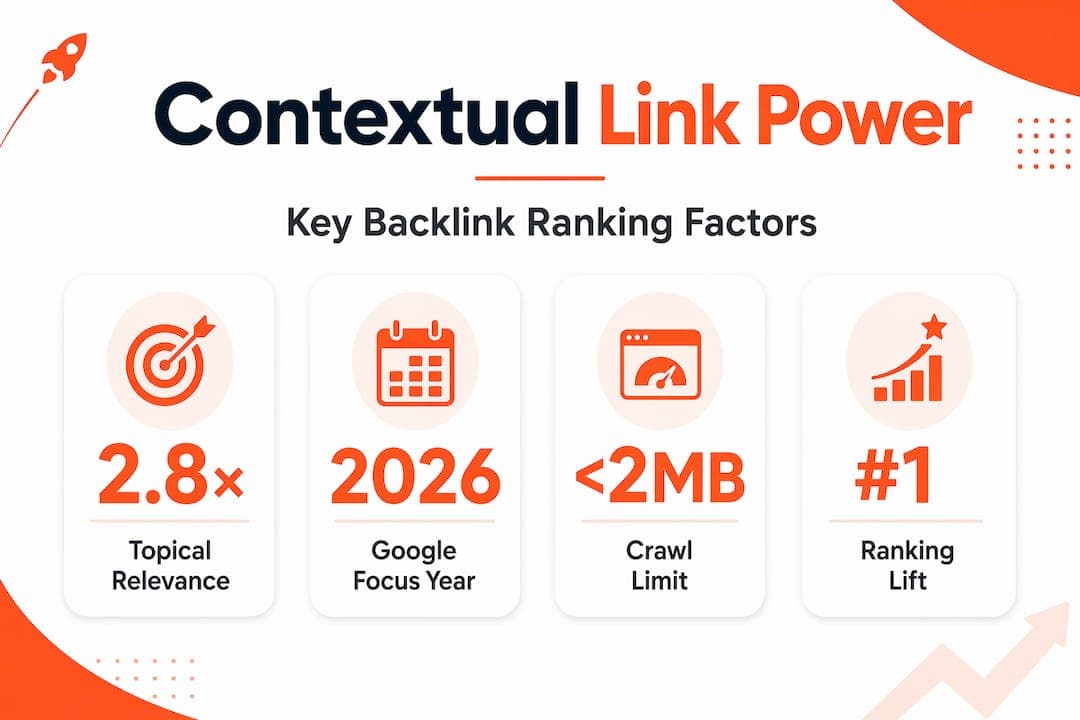
| Topical alignment beats authority alone | Topically matched contextual links produce up to 2.8× greater ranking improvement than off-topic links from equally authoritative sites. |
| Google evaluates link patterns holistically | SpamBrain flags unnatural anchor ratios and link velocity spikes, not just low-quality domains. |
| Technical placement determines crawlability | Links buried beyond Googlebot's 2MB fetch limit or hidden by JavaScript may receive no credit at all. |
| Earn, don't engineer | Editorial links from relationship-based outreach and genuine content assets outperform link schemes under 2026 enforcement guidelines. |
The role of contextual backlinks explained
What makes a backlink "contextual" is not the quality of the domain it comes from. It is where the link lives on the page and what surrounds it. A contextual backlink sits inside the main body text of an article, a report, or an editorial piece. It is embedded within sentences that discuss the same topic as the destination page. A link in a footer navigation, a site-wide widget, or a curated directory does not meet this standard regardless of domain authority.
There are three main types to understand:
- Inbound contextual backlinks: External sites linking to your content from within relevant editorial prose. These carry the most SEO weight.
- Internal contextual links: Links from your own content to other pages on your site, placed within relevant paragraphs. They distribute page authority and improve topical structure.
- Outbound contextual links: Links you place in your content pointing to external sources. These signal editorial credibility and topic awareness.
Here is how these compare to non-contextual link types:
| Backlink type | Placement | Authority passed | SEO impact |
|---|---|---|---|
| Inbound contextual | Editorial body text | High | High ranking signal |
| Footer/sitewide link | Footer or sidebar | Low to none | Minimal, often discounted |
| Directory link | Listings page | Very low | Weak, sometimes spam risk |
| Blog roll link | Sidebar widget | Low | Diluted across all pages |
| Guest post contextual | In-article body | Medium to high | Strong if topically relevant |
The reason inbound contextual backlinks carry stronger editorial signals comes down to intent. When a writer links to your page from within a paragraph that discusses the exact topic your page covers, that link demonstrates that a real person found your content genuinely useful. Algorithms are built to reward exactly that signal.
For a broader look at how backlink types divide by classification, the types of backlinks breakdown from Babylovegrowth covers this in useful detail.
How contextual backlinks influence rankings in 2026
The mechanisms behind contextual link value go beyond the simple "link equals vote" model that defined early SEO. Today, three interlocking factors determine how much ranking power a contextual link actually delivers.
Topical relevance. Contextual backlinks aligned topically with the linked page produce up to 2.8× greater ranking improvements compared to same-authority links from off-topic sources. That is not a marginal difference. A link from a mid-authority site that covers the same niche as your page can outperform a link from a much stronger domain that writes about unrelated subjects.
Semantic co-citation signals. Google reads the words surrounding your link, not just the anchor text itself. If the paragraph mentions your topic, uses related terminology, and frames the link as a natural reference, that semantic context reinforces the link's relevance signal. This matters especially as AI-powered generative search relies on in-text citations to understand entity relationships between pages.
SpamBrain evaluation. Google's SpamBrain system evaluates backlinks not just by placement but also by contextual relevance, domain quality, and link acquisition patterns. Unrelated links trigger spam signals even when they come from high-authority domains. Contextual placement is necessary but not sufficient on its own. The surrounding site quality, linking patterns, and anchor diversity all feed into the final evaluation.
- Strong topical alignment between linking and linked pages
- Natural anchor text that describes the destination without over-optimizing
- Editorial intent visible in the surrounding paragraph
- Linking site with real organic traffic and genuine audience
- Diverse link sources rather than a cluster of related domains
Pro Tip: Before pursuing a link from a site, check whether that site ranks for terms semantically related to your target page. A site ranking for overlapping topics is a far stronger signal than one with high domain authority alone.
Understanding how Google's 2026 updates affect this process is worth reading alongside the Google algorithms and SEO traffic guide published by Babylovegrowth.
Technical factors that affect contextual link credit
You can earn a contextual link from a strong, topically relevant editorial source and still see it deliver almost no SEO value. The reason is usually technical, and many SEO teams miss it entirely.

JavaScript rendering adds another layer of risk. Links loaded dynamically through client-side scripts are only processed during a second-wave render that Googlebot does not always complete. If your contextual link lives inside a JavaScript-rendered component, there is a meaningful chance it passes no link value whatsoever.
Here is a checklist for auditing your most important backlinks:
- Verify HTML placement. Confirm the link exists in the raw HTML source, not injected by JavaScript.
- Check page size. Use fetch tools to assess whether the linking page exceeds or approaches the 2MB HTML limit.
- Confirm indexing. Check whether the linking page is indexed in Google Search Console. An unindexed page cannot pass credit.
- Test rendering. Use Google's URL Inspection tool to compare crawled content with rendered content. If the link disappears in the rendered version, it likely will not be credited.
- Assess link position. Links placed within the first third of a page's content are more reliably processed than links buried after extensive markup or content blocks.
Pro Tip: When negotiating a guest post or link placement, always request that your link appear in the first few hundred words of the article body. This is not just about prominence. It directly improves the probability of consistent crawl credit.
Running a website crawlability audit is one of the fastest ways to identify whether link placements on your own pages meet these technical requirements.
Earning high-quality contextual backlinks the right way
The word "earn" is doing real work here. Organic, editorially given links outperform link schemes and manipulative tactics under Google's 2026 SpamBrain enforcement. The strategies below are not new, but the discipline with which you apply them determines whether your link profile grows sustainably or becomes a liability.
Relationship-based outreach. Genuine relationship building with writers, editors, and site owners in your niche is still the most reliable path to contextual placements. This means engaging with their content before asking for anything, offering data or perspective they can use, and building a track record of adding real value to their work.
Guest blogging done correctly. Guest posts remain effective when the host site has a real audience, the content is genuinely useful, and the link placement is editorially justified by the paragraph it lives in. What destroys this approach is writing shallow content purely to insert a link, or targeting guest post farms that exist only to sell placements.
Broken link reclamation. Find pages in your niche that link to dead resources your content can replace. The outreach success rate is higher because you are offering a clear solution rather than making a cold pitch. The links tend to be well-placed contextually because they were written as genuine editorial references.
Avoiding red flags that trigger penalties:
- Unnatural exact-match anchor text dominating your backlink profile
- Sudden spikes in link velocity with no corresponding content activity
- Links from sites with no organic traffic and thin, auto-generated content
- Networks of sites cross-linking each other on the same IP or hosting cluster
Anchor text diversity is not optional. Blending branded anchors, partial-match phrases, and descriptive generic text is what a natural link profile looks like. SEO teams that force exact-match anchors across the majority of their links consistently underperform and face increased algorithmic scrutiny. You can review practical backlink building tactics that illustrate this balance well.
My take on what most SEO teams still get wrong
I've reviewed hundreds of backlink audits across brands of all sizes, and the same pattern keeps appearing. Teams celebrate link count. They build dashboards tracking how many new referring domains they added this month. Then they wonder why the rankings barely moved.
The real problem is that most links in those tallies are contextually weak. They sit in sidebar widgets, generic resource pages, or guest posts on sites with no real readership. Each one looks like a win on a spreadsheet and delivers almost nothing in practice.
What I've found actually shifts rankings is the combination of topical fit and genuine editorial intent. When another writer cites your content because it helped them explain something to their readers, that link behaves differently from every manufactured placement you've ever bought. Algorithms in 2026 are exceptionally good at recognizing the difference. AI-driven semantic search encodes relationships between topics and entities, so a link from a page that genuinely covers adjacent ground carries an information signal, not just a popularity vote.
My advice is straightforward. Stop measuring link building by volume. Start measuring the percentage of new links that come from pages with real traffic, real audiences, and genuine topical overlap with your content. That single shift in how you report success will change the strategies your team prioritizes. You can learn more about building that kind of scalable backlink foundation without chasing numbers for their own sake.
— MEET
How Babylovegrowth helps you build links that actually work
Knowing the theory is one thing. Executing consistently at scale is where most teams hit a wall.
Babylovegrowth is built specifically for SEO professionals who need to move beyond manual outreach and gut-feel link assessment. The platform's backlink building software automates the discovery and acquisition of contextually relevant placements, filtering by topical alignment and domain quality rather than just authority scores. The SEO link building platform integrates directly with keyword research and content workflows, so every link opportunity you pursue is matched to the pages where it will actually move rankings. From crawlability auditing to anchor text analysis, Babylovegrowth puts the technical oversight layer directly into the workflow. If your team is serious about building a contextual link profile that compounds over time, this is where that work gets done efficiently.
FAQ
What are contextual backlinks?
Contextual backlinks are links placed within the main editorial body content of a page, surrounded by text that is topically relevant to the destination. They differ from footer, sidebar, or directory links because the surrounding content provides editorial justification for the link.
Why do contextual backlinks outperform other link types?
Topically aligned contextual links produce up to 2.8× greater ranking improvement compared to off-topic links from equivalent authority domains. The semantic context around the link reinforces its relevance signal to Google's algorithms.
How does Google evaluate contextual link quality?
Google's SpamBrain system assesses domain quality, topical relevance, and link patterns together. Contextual placement alone is not enough. The linking site must have real traffic, natural anchor diversity, and content that genuinely relates to the linked page.
Can technical issues reduce the value of a contextual backlink?
Yes. Googlebot's 2MB fetch limit means links placed deep in heavy HTML documents may not be processed. Links loaded by JavaScript are also at risk of being missed during the crawl cycle entirely.
What is the most effective way to earn contextual backlinks?
Relationship-based outreach and genuine content creation remain the most effective approaches. Editorially earned links from writers who cite your content because it helps their readers consistently outperform any placement obtained through paid schemes or link networks.