Why Leverage Data-Driven SEO for Organic Growth


TL;DR:
- Data-driven SEO leverages analytics, behavioral metrics, and original research to guide all optimization decisions, resulting in measurable growth. It emphasizes precision, content refinement through user engagement data, and original data signals to build authority and differentiate from competitors. Implementing this approach involves connecting data sources, structuring content for measurable insights, and continuously acting on performance metrics.
Data-driven SEO is defined as the practice of using analytics, behavioral metrics, and original research to guide every decision in your search engine optimization strategy. Unlike intuition-based approaches, this method treats traffic data, keyword segmentation, and user engagement signals as the primary inputs for content and technical decisions. Tools like Google Analytics, SEMrush, and Google Search Console give you a factual baseline that generic SEO checklists simply cannot match. Google's 2026 guidance from John Mueller confirms that quality and unique content remain the foundation of ranking, and original data is the clearest proof of both. If you want measurable organic growth, understanding why to use data for SEO is no longer optional.

What advantages does data-driven SEO provide over traditional approaches?
Data-driven SEO replaces guesswork with evidence, and that shift produces measurable ranking advantages that opinion-based SEO cannot replicate. Traditional SEO often relies on broad best practices applied uniformly across a site. Data-driven SEO, by contrast, diagnoses specific problems and targets specific opportunities using real numbers.
The most direct benefit is precision. When you segment keyword data by search intent, device type, and conversion rate, you stop wasting budget on traffic that never converts. Google Analytics and SEMrush both surface this segmentation natively, but the insight only becomes useful when you act on it systematically rather than reactively.
Content quality improves dramatically when behavioral data informs your decisions. Metrics like scroll depth, time on page, and bounce rate tell you exactly where readers disengage. You can then restructure those sections, add supporting data, or replace weak paragraphs with original research. This loop between data and content is what separates sites that grow from sites that plateau.
The credibility benefit is equally significant. Google's E-E-A-T framework (Experience, Expertise, Authoritativeness, Trustworthiness) rewards content that demonstrates first-hand knowledge. Original data is the clearest signal of that knowledge. Content built on original data or research achieved 61% more organic traffic growth than broadly covered content. That gap exists because original data gives both readers and search engines something they cannot find elsewhere.
- Keyword precision: Segment by intent, not just volume, to target queries that convert.
- Content refinement: Use scroll depth and engagement metrics to identify and fix weak sections.
- E-E-A-T signals: Publish original research, surveys, or proprietary data to build authority.
- Competitive differentiation: Sites with unique data attract backlinks organically, compounding domain authority over time.
Pro Tip: Run a quarterly content audit using Google Search Console's Performance report. Filter for pages with high impressions but low click-through rates. Those pages have ranking potential you are not capturing, and a data-informed title or meta description rewrite often fixes the gap within 60 days.
How do predictive analytics empower data-driven SEO strategies?
Predictive analytics in SEO is the practice of using historical search patterns, seasonal trends, and SERP volatility data to forecast future demand before it peaks. This is the role of predictive SEO analytics: shifting your strategy from reactive to anticipatory. Most marketers publish content after a trend peaks. Predictive analytics lets you publish before it does.
The mechanics are straightforward. Google Trends API data, combined with your own CRM and site analytics, reveals cyclical demand patterns for your core topics. Predictive analytics can forecast search demand three to six months ahead, giving content teams enough lead time to research, write, and build authority before competitors notice the opportunity. That window is a genuine competitive advantage.
Here is a practical framework for integrating predictive analytics into your content calendar:
- Export 24 months of keyword data from Google Search Console and identify seasonal spikes by topic cluster.
- Cross-reference with Google Trends to confirm whether spikes are growing, stable, or declining year over year.
- Map content gaps by comparing your existing published URLs against the forecasted high-demand topics.
- Schedule content production 90 days before the projected demand peak to allow for indexing and link acquisition.
- Monitor SERP volatility using tools like Semrush Sensor to detect algorithm shifts that may accelerate or dampen your forecasted traffic.
SEO analytics is shifting from descriptive reporting to predictive and strategic decision-making that integrates AI citation metrics, sentiment analysis, and direct business outcomes. That shift means the marketers who invest in predictive infrastructure now will hold structural advantages that are difficult for competitors to close quickly.
Pro Tip: Set up a Google Trends alert for your three highest-revenue keyword clusters. When a related topic shows a breakout trend signal, treat it as a 72-hour content sprint trigger. Early movers on breakout queries often capture featured snippets that persist for months.
What impact did Google's May 2026 core update have on AI content and original data?
Google's May 2026 core update is the clearest signal yet that the search engine actively distinguishes between AI-generated content and content grounded in original human expertise. The update targeted sites that published high volumes of AI-written content without adding first-hand knowledge, proprietary data, or authentic author credentials.
The results were stark. 34% of sites using primarily AI-generated content saw ranking decreases after the update. By contrast, sites that combined AI efficiency with original research and authentic author credentials saw ranking recovery and growth. That 34% figure represents a structural penalty, not a temporary fluctuation.
| Content approach | Post-update ranking outcome |
|---|---|
| Primarily AI-generated, no original data | 34% saw ranking decreases |
| AI-assisted with original research and author credentials | 23% saw ranking improvements |
| Human-authored with first-hand expertise and screenshots | Strongest recovery and growth |
"Optimizing for generative AI in Google Search is an extension of SEO fundamentals, not a replacement for them. Strong data-driven SEO fundamentals remain foundational." — John Mueller, Google Search Central, May 2026
The practical takeaway is not to abandon AI tools. It is to treat AI as a production accelerator while keeping original data as the content's core value. No special AI content files or rewrites are necessary; Google recommends focusing on crawlability, content quality, and semantic structure first. What the update penalized was the absence of human expertise, not the presence of AI assistance.
Sites that recovered fastest after the update shared three characteristics: they included original screenshots or proprietary data visualizations, they published detailed author bios with verifiable credentials, and they cited primary sources rather than summarizing secondary ones. These are all elements of a mature data-driven SEO practice, which is precisely why the update reinforced rather than disrupted the strategies already working for data-informed teams.
How to implement a data-driven SEO strategy for your business
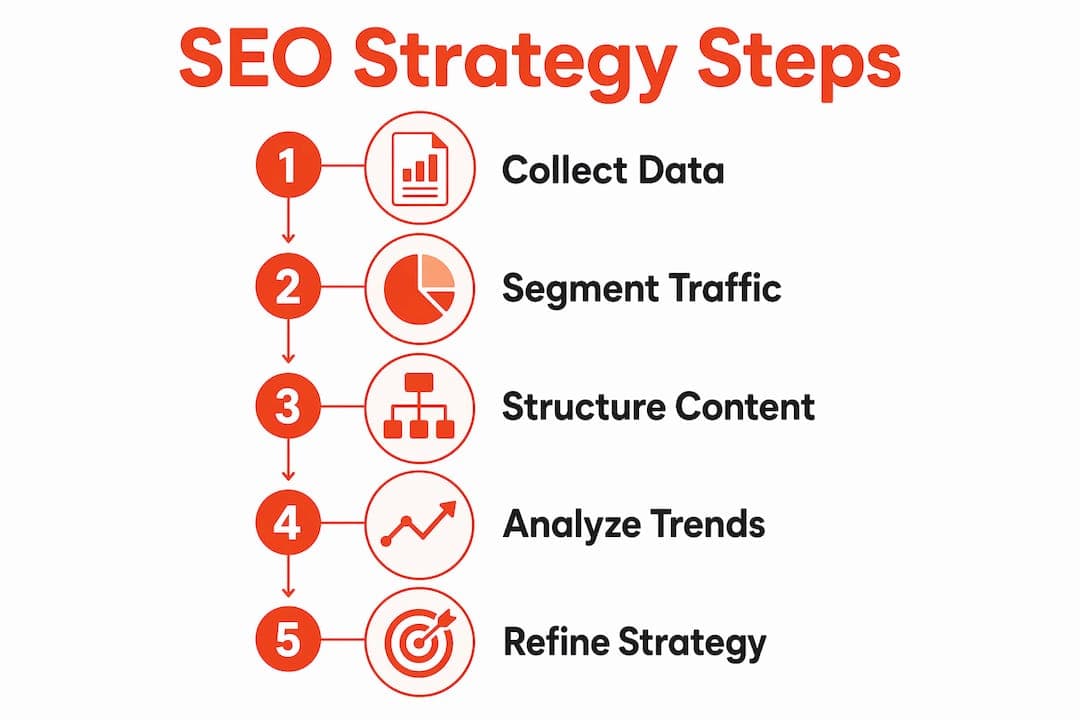
A data-driven SEO strategy is built in layers, starting with data collection and ending with a continuous refinement loop tied to specific KPIs. The core of this approach is using metrics like traffic, engagement, and keyword segmentation to diagnose SEO issues and guide every action.
Layer 1: Data collection and segmentation
Start by connecting Google Analytics 4, Google Search Console, and your CRM into a single reporting view. Segment traffic by channel, device, and landing page. Identify which pages drive conversions, not just visits. This baseline tells you where your SEO is already working and where it is leaking value.
Layer 2: Content structuring for data extraction
Design every piece of content to contain at least one citable, measurable insight. Original data functions as a retrieval primitive for AI and search engines, making your content more likely to appear in AI-generated answers and featured snippets. Use clear formatting, descriptive headers, and data tables so both humans and crawlers can extract your key findings efficiently. This is how you build topical authority that compounds over time.
Layer 3: Testing and KPI tracking
- Set measurable KPIs before publishing: target ranking position, click-through rate, and conversion rate per page.
- Run A/B tests on title tags and meta descriptions using Google Search Console impression and click data.
- Review performance at 30, 60, and 90 days post-publication and adjust based on actual SERP behavior.
- Track backlink acquisition per piece of content. Original data attracts links passively; generic content does not.
The most common implementation failure is collecting data without acting on it. A weekly 30-minute review of your top 20 pages by impressions, using Search Console filtered by query, produces more actionable decisions than a monthly deep-dive report that nobody reads. For a broader view of how AI integrates with content strategy, the connection between data signals and content decisions is where most growth happens.
Pro Tip: Build a "content decay" tracker in Google Sheets that pulls Search Console data monthly. Flag any page that loses more than 20% of its impressions quarter over quarter. Decaying pages are your fastest wins because they already have authority. Updating them with fresh data and original insights typically restores rankings within 45 days.
Key takeaways
Data-driven SEO outperforms intuition-based approaches because original research, behavioral metrics, and predictive analytics give your content the authority and precision that generic optimization cannot produce.
| Point | Details |
|---|---|
| Original data drives traffic | Content with original research earns 61% more organic traffic than broadly covered content. |
| Predictive analytics creates timing advantage | Forecasting demand 3 to 6 months ahead lets you publish before competitors notice the opportunity. |
| Google's 2026 update penalizes thin AI content | 34% of AI-only sites lost rankings; combining AI with original data produced gains instead. |
| Data collection must connect to action | Weekly Search Console reviews of top pages produce more decisions than monthly passive reports. |
| E-E-A-T signals require original evidence | Author credentials, proprietary data, and first-hand screenshots are the fastest path to ranking recovery. |
Why I stopped trusting SEO instincts and started trusting the data
The honest truth about SEO in 2026 is that the practitioners still running on instinct are losing ground to those who treat their analytics stack as a primary source of truth. I have watched campaigns built on "content best practices" flatline while nearly identical campaigns grounded in original survey data and behavioral segmentation grew month over month. The difference was not the writing quality. It was the evidentiary foundation.
What changed my thinking was watching the May 2026 core update hit sites that had done everything "right" by conventional standards. They had good structure, reasonable keyword targeting, and clean technical setups. But they had no original data. No first-hand expertise signals. No proprietary insights that a reader could not find in five other places. Google's algorithm, increasingly shaped by AI evaluation, simply could not distinguish them from the noise.
The counterintuitive lesson is that data-driven SEO is not primarily about tracking more metrics. It is about producing content that contains original, citable evidence. The tracking tells you what to fix. The original data tells search engines and AI systems why your content deserves to rank. Those are two different disciplines, and most teams only practice one of them.
For anyone building an SEO strategy right now, the AI-driven search visibility shift means your content needs to be citable by machines, not just readable by humans. That requires a fundamentally different approach to research and publication. Start with one original data point per content piece and build from there.
— MEET
How Babylovegrowth helps you build a data-driven SEO engine
Babylovegrowth is built specifically for digital marketers and business owners who want the benefits of data-driven SEO without assembling a dozen separate tools. The platform's keyword discovery platform uses AI to surface hidden keyword opportunities that standard volume-based research misses, giving your content calendar a data foundation from day one. The backlink building software automates link acquisition at scale, so your original content earns the authority signals it deserves. Combined with daily SEO articles, automatic structured data markup, and a built-in AI SEO audit, Babylovegrowth turns data-informed strategy into consistent, compounding organic growth without requiring a full-time analytics team.
FAQ
What is data-driven SEO?
Data-driven SEO is the practice of using analytics, behavioral metrics, and original research to guide SEO decisions rather than relying on generic best practices or intuition. It focuses on measurable inputs like keyword segmentation, traffic patterns, and engagement data to improve rankings and organic traffic.
Why does original data improve SEO performance?
Original data gives search engines and AI systems a unique, citable signal that generic content cannot provide. Content built on original research earns 61% more organic traffic growth than broadly covered content, according to PragoMedia's 2026 analysis.
How does predictive analytics fit into an SEO strategy?
Predictive analytics uses historical search patterns and seasonal trends to forecast demand three to six months ahead, allowing you to publish content before competitors identify the same opportunity. Tools like Google Trends and CRM-integrated data models are the standard starting points for this approach.
Did Google's May 2026 update change how AI content ranks?
Yes. The May 2026 core update resulted in ranking decreases for 34% of sites relying primarily on AI-generated content without original data or author expertise. Sites that combined AI production with first-hand research and verified author credentials saw ranking improvements instead.
How do you start implementing data-driven SEO practices?
Connect Google Analytics 4, Google Search Console, and your CRM into a unified reporting view, then segment traffic by conversion behavior rather than volume alone. From there, build a content decay tracker, schedule quarterly keyword audits, and commit to including at least one original, citable data point in every piece you publish.