What Is Search Engine Indexation: 2026 SEO Guide


TL;DR:
- Search engine indexation transforms crawled web pages into a structured database for quick search retrieval.
- Crawled content does not guarantee inclusion in the index, as filters exclude low-quality or duplicate pages.
Search engine indexation is the process by which search engines analyze, store, and organize web page content into a structured database called the index, enabling fast retrieval of relevant results during user searches. Without indexation, your pages cannot appear in Google, Bing, or AI-driven search engines like Perplexity or ChatGPT, regardless of how well-written or well-linked they are. Understanding what is search engine indexation is the first step toward fixing the most common reason sites fail to rank. Googlebot discovers your pages through crawling, but crawling alone does not guarantee a place in the index. The distinction matters enormously for every website owner and digital marketer managing organic traffic.
What is search engine indexation and how does it work?
Search engine indexation is the process that transforms a crawled web page into a retrievable database entry. Indexing organizes crawled data into a structured database, enabling search engines to return results in milliseconds rather than scanning the live web in real time. That speed difference is not trivial. A live web scan could take hours. A pre-indexed database answers a query almost instantly.
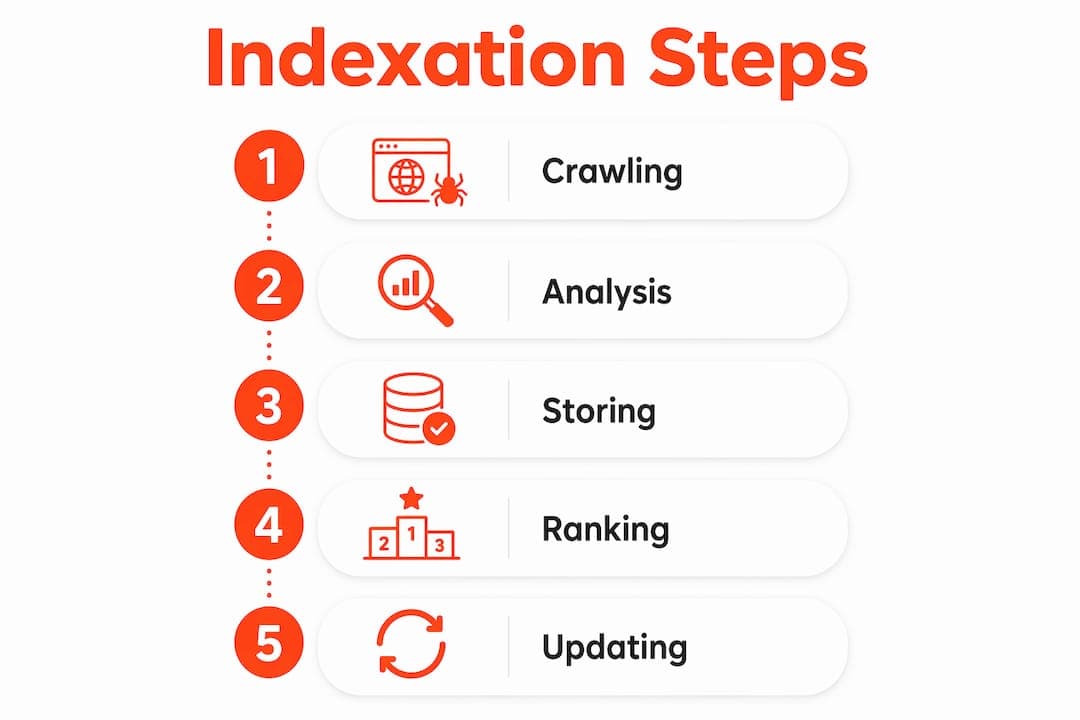
The indexing pipeline follows a clear sequence:
- Discovery. Googlebot finds a URL through a sitemap, an internal link, or an external backlink.
- Crawling. The bot fetches the page's HTML, JavaScript, CSS, and media assets.
- Analysis. Google parses the content, extracts entities, evaluates quality signals, and checks technical directives like
noindexmeta tags and canonical tags. - Filtering. Pages that are duplicate, thin, or technically non-compliant are excluded. Search engines in 2026 index roughly 10% of crawled pages, aggressively filtering out duplicates, low-quality, and non-compliant content. That means nine out of ten crawled pages never enter the index.
- Storage. Accepted pages are written into two parallel structures: a traditional inverted index for keyword matching and a dense vector index for semantic search. Modern indexing pipelines include dense vector indexes using ANN algorithms like ScaNN and HNSW alongside traditional inverted indexes, enabling semantic ranking even without exact keyword matches.
One additional development reshapes how content structure matters. Google's passage indexing allows individual paragraphs to rank independently, expanding relevance beyond full-page signals to specific content segments. A single well-written paragraph buried in a long article can now surface for a targeted query on its own.
Pro Tip: Use Google Search Console's URL Inspection tool to check whether a specific page is indexed and to see the last crawl date, rendered HTML, and any indexing errors before troubleshooting further.

What common misconceptions exist about search engine indexing?
The biggest misconception in search engine indexing explained simply: being crawled does not mean being indexed. Crawled content does not guarantee index inclusion because quality and uniqueness filters run after the crawl. Many site owners see Googlebot in their server logs and assume their pages are live in search. They are not necessarily.
Other misconceptions that cost marketers real traffic:
- Crawling equals indexing. These are separate sequential stages. A page must be crawled, indexed, and ranked sequentially. Failure at any stage blocks search visibility entirely.
- Submitting a sitemap guarantees indexing. Sitemaps help Google discover URLs, but they do not override quality filters. A sitemap full of thin pages will not produce indexed pages.
- Thin content only affects rankings. Thin or duplicate content causes pages to be excluded from the index entirely, not just ranked lower. Pages leave indexes due to meta directives, errors, duplicate canonical clustering, or low quality, and Google's helpful content systems have raised those quality thresholds significantly.
- Orphaned pages get indexed eventually. Orphaned pages lacking internal or external links are often ignored by crawlers entirely. Sitemaps help but are secondary to link discovery for crawling and indexing.
- A
noindextag is the only way to block indexing. Canonicalization, 404 errors, and low-quality signals all remove pages from the index without any explicit directive from the site owner.
Pro Tip: Run a site:yourdomain.com search in Google to get a rough count of indexed pages. Compare that number against your total published URLs to spot large indexation gaps quickly.
How can website owners improve their pages' indexation?
Improving indexation requires action on both content quality and technical SEO. Indexability depends on both technical signals and content quality. Google evaluates pages before indexing them, so passing that evaluation is the goal.
Content quality and structure
Write pages that answer a specific question clearly and completely. Avoid publishing multiple pages that cover the same topic with minor variations. Duplicate content triggers canonical clustering, which pushes one version out of the index. For content structure, write each section as a focused, self-contained answer. This approach directly supports passage indexing, where individual paragraphs can rank for specific queries. Check out this content strategy guide for frameworks that meet Google's quality criteria.
Technical SEO elements
| Technical Element | What to Check | Why It Matters |
|---|---|---|
| Meta robots tag | No unintended noindex directives | Prevents pages from being blocked at the analysis stage |
| Canonical tags | Self-referencing canonicals on original pages | Prevents duplicate clustering that removes pages from the index |
| XML sitemap | All priority URLs listed and submitted | Speeds up discovery for new and updated content |
| Internal links | Every page linked from at least one other page | Eliminates orphaned pages that crawlers miss |
| robots.txt | No accidental blocking of key pages or assets | Ensures Googlebot can access CSS, JS, and images for rendering |
Internal linking and crawl paths
Internal linking plays a crucial but often overlooked role in ensuring important pages get crawled and indexed efficiently. A page with no inbound internal links is effectively invisible to crawlers. Build logical link paths from your highest-traffic pages down to deeper content. Read more about proven internal linking strategies to build crawl paths that work.
Auditing for indexability
Run a technical audit at least quarterly. Tools like Google Search Console, Screaming Frog, and Babylovegrowth's AI crawlability audit surface issues like blocked resources, redirect chains, and missing canonical tags before they cause indexation failures.
How does indexation influence overall SEO strategy?
Indexation is the invisible foundation of SEO. Without it, content is invisible to search engines despite being crawled. This makes indexation the gatekeeper for all downstream SEO work, including ranking, traffic, and conversions.
The relationship between indexation rates and organic traffic is direct. If 40% of your published pages are not indexed, you are losing roughly 40% of your potential organic surface area before any ranking factor even applies. Content updates, backlink campaigns, and keyword targeting all produce zero results for non-indexed pages.
Monitoring indexation health requires three regular checks:
- Google Search Console Coverage Report. This shows indexed pages, excluded pages, and the specific reason for each exclusion. Review it weekly for new errors.
- URL Inspection Tool. Use this to test individual pages after publishing or after making technical changes. It shows the rendered HTML Google sees, not just the raw source.
- Crawl audits. A full site crawl with Screaming Frog or Babylovegrowth's audit tools maps every URL, its indexability status, and any blocking directives. Run one after major site changes.
Aligning content updates with indexation cycles also matters. Google recrawls pages at different frequencies based on authority and update history. High-authority pages get recrawled within hours. New or low-authority pages may wait days or weeks. Publishing updates to important pages and then requesting recrawl via Search Console shortens that cycle. Understanding search engine visibility as a whole helps connect indexation decisions to traffic outcomes.
Key takeaways
Search engine indexation is the gatekeeper of organic search visibility, and no ranking strategy works until your pages pass Google's crawl, quality, and technical filters to enter the index.
| Point | Details |
|---|---|
| Indexation precedes ranking | A page must be crawled, indexed, and ranked in sequence. Failure at any stage blocks search visibility. |
| Most crawled pages are filtered out | Search engines index roughly 10% of crawled pages. Quality, duplication, and technical signals determine inclusion. |
| Crawling is not indexing | Seeing Googlebot in your logs does not confirm a page is indexed. Check Google Search Console directly. |
| Internal links drive crawl coverage | Orphaned pages without inbound links are regularly missed by crawlers. Every page needs at least one internal link. |
| Passage indexing rewards structure | Writing focused, self-contained sections improves the chance that individual paragraphs rank for specific queries. |
Why indexation deserves more attention than most SEO checklists give it
Most SEO conversations jump straight to keywords, backlinks, and content length. Indexation gets treated as a checkbox rather than a discipline. That is a mistake I see repeatedly when auditing sites that have strong content but flat organic traffic.
The shift toward semantic vector indexing changes the stakes. Google no longer needs exact keyword matches to understand a page. It builds a semantic representation of your content and stores it in a dense vector index alongside the traditional inverted index. That means poorly structured content, even if it contains the right keywords, can fail to represent its topic clearly enough to pass quality filters. Writing for semantic clarity is now as important as writing for keyword relevance.
The passage indexing development is equally underappreciated. A single sharp, well-structured paragraph can now rank independently for a query that the full page might never target. Site owners who write long, unfocused pages are leaving dozens of potential ranking opportunities on the table. Breaking content into tight, self-contained sections is not just a readability choice. It is an indexation strategy.
The most overlooked pitfall remains orphaned pages. I have audited sites where 20–30% of published URLs had zero inbound internal links. Those pages were crawled occasionally through the sitemap but never consistently indexed. The fix is simple: build a logical internal link structure and audit it regularly. Sitemaps are a backup, not a primary discovery mechanism.
Indexation is not a one-time setup task. It is an ongoing process that requires monitoring, auditing, and alignment with your content publishing schedule. Treat it that way and your organic traffic will reflect it.
— MEET
Get your pages indexed faster with Babylovegrowth
Babylovegrowth gives website owners and digital marketers the tools to identify and fix indexation gaps before they cost organic traffic. The AI crawlability audit scans your site for technical issues that block Googlebot, including missing canonical tags, blocked resources, and orphaned pages. The keyword discovery platform surfaces high-value keyword opportunities tied to content your site has not yet indexed, so you can publish with purpose. Both tools connect directly to Babylovegrowth's automated content and SEO pipeline, turning indexation insights into published, structured content that meets Google's quality thresholds.
FAQ
What is the difference between crawling and indexing?
Crawling is the process of discovering and fetching web pages. Indexing is the separate process of analyzing, filtering, and storing those pages in a searchable database. A page can be crawled without ever being indexed.
Why is my page crawled but not indexed?
Google evaluates pages for quality, uniqueness, and technical compliance after crawling. Pages with thin content, duplicate signals, or improper meta directives are excluded from the index even after a successful crawl.
How long does indexation take after publishing?
High-authority pages can be indexed within hours after a recrawl request in Google Search Console. New or low-authority pages may take days to weeks depending on crawl frequency and site authority.
What is passage indexing and why does it matter?
Passage indexing allows Google to rank individual paragraphs independently from the full page. Writing focused, self-contained sections increases the chance that specific parts of your content surface for targeted queries.
How do I check if my pages are indexed?
Use Google Search Console's Coverage Report for a full site view or the URL Inspection tool to check individual pages. A site:yourdomain.com search in Google also gives a rough count of indexed pages.