Utilizing Analytics Tools to Boost Organic SEO Success


Relying on patchy analytics data can leave E-commerce teams guessing instead of growing. Consistent, reliable SEO tracking depends on pulling the right numbers from every corner of your digital presence, not just scraping a few surface metrics. By focusing on clean, well-organized data sources and effective integration steps, you set the groundwork for actionable insights that drive true organic growth, making your SEO workflow smoother and more scalable.
Table of Contents
- Step 1: Prepare Data Sources For Analytics Integration
- Step 2: Connect And Configure Analytics Tools Effectively
- Step 3: Analyze Traffic And Keyword Performance Metrics
- Step 4: Optimize Content Strategies Using Actionable Insights
- Step 5: Verify Improvements And Measure Organic Growth
Quick Summary
| Key Insight | Explanation |
|---|---|
| 1. Prepare diverse data sources | Collect data from platforms like Google Analytics and social media to gain a comprehensive view. |
| 2. Connect analytics tools properly | Ensure compatibility and set secure tracking parameters for accurate insights in SEO performance. |
| 3. Analyze key performance metrics | Focus on metrics such as organic traffic and keyword rankings to identify opportunities for growth. |
| 4. Optimize content strategies | Use audience engagement data to refine content and enhance user experiences across platforms. |
| 5. Verify organic growth | Regularly measure SEO performance to assess strategy effectiveness and uncover areas for improvement. |
Step 1: Prepare data sources for analytics integration
Preparing robust data sources is crucial for effective SEO analytics integration. This step involves systematically collecting and organizing data from multiple platforms to create a comprehensive view of your digital performance.
Start by identifying relevant data sources across different channels. These typically include:
- Google Analytics
- Google Search Console
- Social media platform analytics
- Web server logs
- Email marketing platforms
- Customer relationship management (CRM) systems
The goal is to integrate diverse data formats that provide a holistic understanding of your organic search performance. Data preparation requires careful attention to cleaning, deduplication, and normalization.

Here's a summary of how key analytics platforms contribute to SEO strategy:
| Platform | Unique Function | Data Scope |
|---|---|---|
| Google Analytics | Tracks site usage patterns | Traffic, engagement, conversion |
| Google Search Console | Monitors search visibility | Impressions, queries, indexing |
| Social Media Analytics | Measures social impact | Audience, shares, engagement |
| CRM Systems | Links web actions to leads | User journeys, sales attribution |
| Email Marketing Platforms | Connects email and web data | Open rates, CTR, conversions |
| Web Server Logs | Reveals technical SEO issues | Crawling, errors, server response |
Implement a structured approach to data collection by:
- Export raw data from each platform
- Standardize date ranges and tracking parameters
- Remove duplicate or incomplete records
- Validate data integrity and consistency
- Create a centralized data repository
Successful analytics integration depends on having clean, consistent, and comprehensive data sources.
Pro tip: Develop a standardized data collection template to streamline future analytics integration processes and ensure consistent tracking across all platforms.
Step 2: Connect and configure analytics tools effectively
Connecting and configuring your analytics tools is a critical step in establishing a comprehensive SEO performance tracking system. This process requires strategic planning and careful integration to ensure accurate and actionable insights.
Begin by establishing clear data integration workflows that align with your business objectives. Your configuration strategy should focus on several key areas:
- Verify compatibility between different analytics platforms
- Ensure secure authentication methods
- Set up consistent tracking parameters
- Map data fields across multiple systems
- Configure reporting dashboards
API connections are the backbone of effective tool integration. Most modern analytics platforms offer native connection options that simplify the process:
- Generate API keys from each platform
- Select a primary analytics dashboard
- Configure data mapping settings
- Test data synchronization
- Validate data accuracy and completeness
Successful analytics configuration transforms raw data into strategic business intelligence.
Carefully review privacy settings and access controls to protect sensitive information during the integration process. Many platforms offer granular permissions that allow you to control data visibility and user access.
Pro tip: Create a backup of your existing analytics configurations before making major changes to prevent potential data loss or disruption.
Step 3: Analyze traffic and keyword performance metrics
Analyzing traffic and keyword performance metrics is essential for understanding your website's organic search success and identifying opportunities for improvement. This step transforms raw data into strategic insights that can drive your SEO strategy forward.
Start by exploring essential SEO metrics to track across your primary analytics platforms. Focus on key performance indicators that reveal your organic search effectiveness:
- Organic search traffic volume
- Keyword ranking positions
- Click-through rates (CTR)
- Bounce rates
- Conversion rates from organic search
- Average session duration
Detailed keyword analysis requires a systematic approach to uncovering performance patterns:
- Identify top-performing keywords
- Analyze search intent behind keywords
- Compare keyword rankings over time
- Examine competitor keyword strategies
- Discover emerging keyword opportunities
Successful SEO metrics analysis transforms data points into actionable strategic insights.
Pay close attention to long-tail keywords that might represent niche but high-conversion potential. These specific search terms often indicate more targeted user intent and can provide valuable opportunities for content optimization.
Pro tip: Create a monthly dashboard that tracks your most critical SEO performance metrics to quickly identify trends and make data-driven optimization decisions.
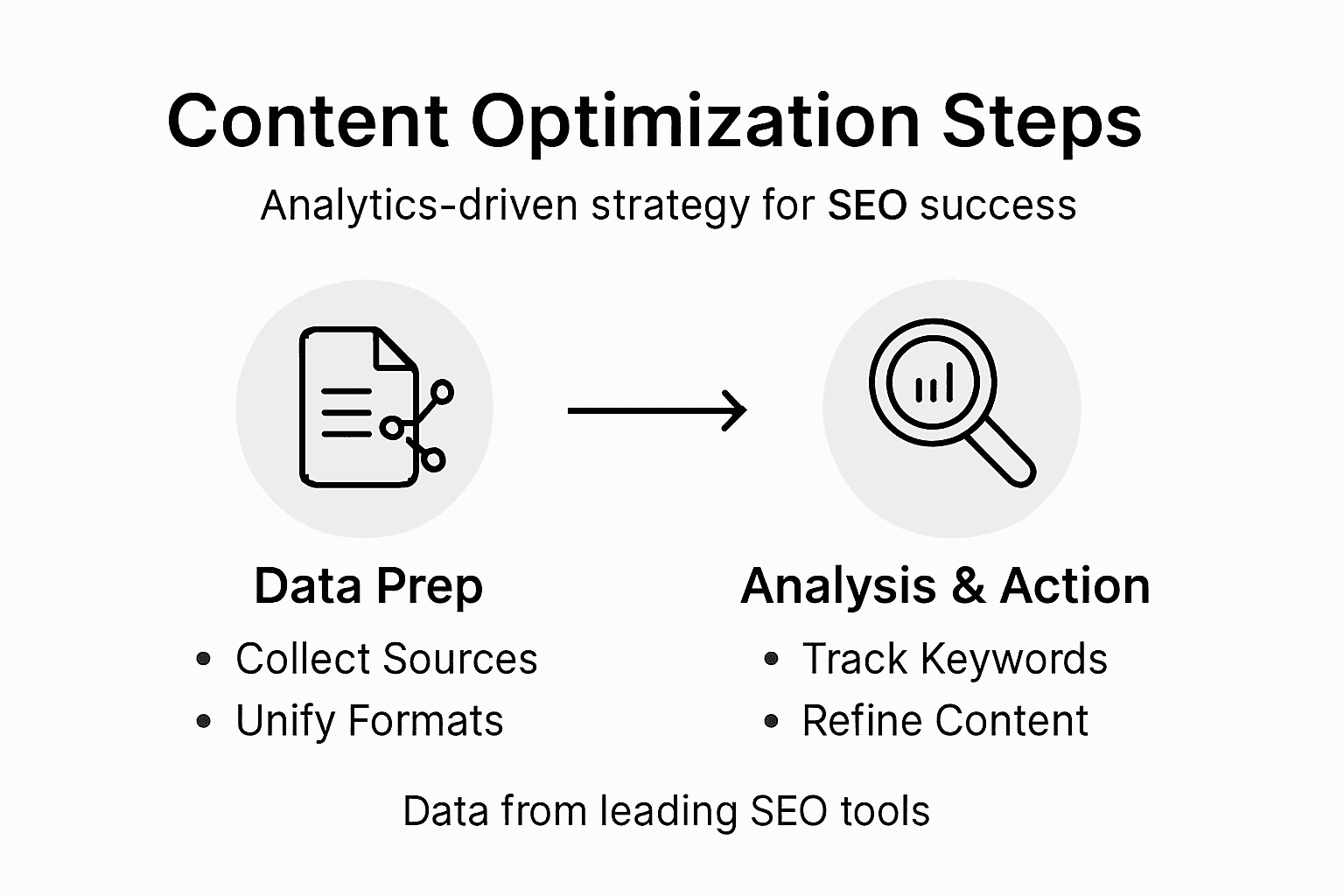
Step 4: Optimize content strategies using actionable insights
Optimizing your content strategy requires transforming raw analytics data into targeted, impactful improvements. Advanced AI-driven content analysis can help you develop a more responsive and engaging approach to your digital content.
Implement a comprehensive content optimization strategy by focusing on these key areas:
- Identify high-performing content topics
- Analyze audience engagement metrics
- Benchmark against competitor content
- Uncover content gaps and opportunities
- Refine content based on user intent
Content optimization techniques require a systematic approach:
- Review top-performing content
- Analyze user behavior and interaction patterns
- Identify underperforming content segments
- Develop targeted content improvements
- Implement and track content modifications
Data-driven content strategies transform generic material into precision-targeted audience experiences.
Pay special attention to content optimization best practices that align with your specific audience needs. Audience-centric optimization means going beyond surface-level metrics to understand deeper engagement signals.
Pro tip: Create a quarterly content performance review that combines quantitative metrics with qualitative insights to continuously refine your content strategy.
Step 5: Verify improvements and measure organic growth
Measuring organic growth goes beyond simple performance tracking, requiring a comprehensive analysis of your digital strategy's effectiveness. Strategic assessment of growth capabilities enables you to understand the true impact of your SEO efforts.
Establish a robust verification framework by monitoring these critical metrics:
- Organic search traffic trends
- Keyword ranking progression
- Conversion rate improvements
- Domain authority changes
- Backlink quality and quantity
- Engagement metrics
Performance verification techniques involve systematic evaluation:
- Compare current metrics with baseline data
- Analyze month-over-month performance trends
- Identify significant improvements or regressions
- Calculate incremental gains in key performance indicators
- Document quantitative and qualitative insights
Consistent measurement transforms SEO from a tactical activity to a strategic growth driver.
Utilize advanced SEO performance tracking methods to create a comprehensive view of your digital marketing success. Holistic growth analysis means looking beyond surface-level metrics to understand deeper performance signals.
Compare different approaches to measuring organic growth and SEO improvement:
| Measurement Approach | Depth of Insight | Best Use Case |
|---|---|---|
| Month-over-Month Trend Analysis | Detects sustained progress | Long-term performance monitoring |
| Baseline Metrics Comparison | Highlights changes | Evaluating impact of new tactics |
| Qualitative Review | Adds context to data points | Identifying actionable insights |
| Incremental KPI Calculations | Shows compounding growth | Assessing strategic effectiveness |
Pro tip: Create a quarterly performance dashboard that visualizes your key growth metrics, making it easy to communicate progress to stakeholders and identify strategic opportunities.
Unlock True SEO Potential with AI-Driven Analytics Integration
The article highlights the challenge of managing diverse data sources and connecting multiple analytics tools to deliver clear, actionable SEO insights. If you find cleaning and unifying complex data overwhelming or struggle to translate keyword performance and traffic metrics into measurable growth, you are not alone. Pain points like these can stall your organic search success and make content optimization feel like a guessing game.
At Babylovegrowth.ai, we simplify this complexity by offering an all-in-one AI-powered platform designed to automate your SEO workflow—from data analysis to optimized content creation. Our system generates personalized 30-day content plans based on real keyword opportunities and uses actionable insights to continuously boost your Google and ChatGPT rankings. With features like automated backlink exchange and detailed business analysis, you can turn scattered analytics into strategic, scalable organic growth without needing costly tools or agencies.
Ready to take full control of your SEO success without wasting time on manual data integration?

Experience how effortless SEO can be with AI-powered automation driving your traffic, rankings, and conversions. Start your free trial at Babylovegrowth.ai now and transform your organic growth strategy into a predictable machine. Visit our landing page and let us handle the complexity so you can focus on growing your business.
Frequently Asked Questions
How can I effectively prepare my data sources for SEO analytics integration?
Start by identifying all relevant data sources such as Google Analytics, Google Search Console, and social media analytics. Systematically export raw data from these platforms, clean it, and standardize it to create a comprehensive repository for analysis.
What analytics tools should I connect for a holistic view of organic SEO performance?
Connect essential platforms like Google Analytics, Google Search Console, and CRM systems to gather diverse insights. Verify compatibility and establish clear mapping of data fields to ensure seamless integration and accurate reporting.
What key metrics should I analyze to improve my organic search performance?
Focus on metrics such as organic traffic volume, keyword rankings, click-through rates, and conversion rates. Regularly review these metrics to identify trends and areas that require optimization, aiming for improvements each month.
How can I optimize my content strategy based on analytics insights?
Identify high-performing content topics and analyze audience engagement metrics to refine your content strategy. Implement targeted improvements based on user behavior insights and track changes to see results within a few months.
How do I verify the effectiveness of my SEO improvements?
Measure organic search traffic trends, keyword ranking progress, and conversion rates to verify your SEO strategies. Conduct these evaluations quarterly to capture significant changes and document insights that guide future adjustments.