SEO Copywriting Guide for Marketing Pros in 2026


TL;DR:
- SEO copywriting combines keyword research, content structure, and persuasive writing to improve search engine rankings and user engagement. Most underperforming content results from misinterpreting search intent or neglecting metadata and internal linking. Regular updates, thorough analysis, and structured content are essential for sustained organic growth.
SEO copywriting is the practice of crafting web content that satisfies search engine algorithms and human readers at the same time, with the goal of driving organic rankings and conversions. Organic search drives 53% of all website traffic, making it the single largest discovery channel for most businesses. Yet 8 out of 10 SEO articles underperform because they fail to match search intent or outperform existing top results. This SEO copywriting guide gives marketing professionals and business owners a direct, proven framework to close that gap in 2026.
What is an SEO copywriting guide and why does it matter?
SEO copywriting, also called search-optimized content writing, is a hybrid discipline. It combines keyword research, metadata optimization, semantic SEO, and persuasive writing to produce content that ranks and converts. The industry term for the underlying quality standard is Google's E-E-A-T framework, which stands for experience, expertise, authoritativeness, and trustworthiness.
Google's E-E-A-T principles are the primary quality signals that determine whether a page earns a top ranking. That means thin, generic content written purely for keyword density will not rank, regardless of how many times the target phrase appears. The dual goal is always to satisfy the algorithm and to give the reader a reason to stay, engage, and act.
Understanding this distinction separates copywriters who produce filler from those who produce assets. Every piece of SEO copy should be designed as the clearest, most complete answer to a specific query. That design intent, not luck, is what drives consistent organic growth.
What prerequisites and tools are essential for effective SEO copywriting?
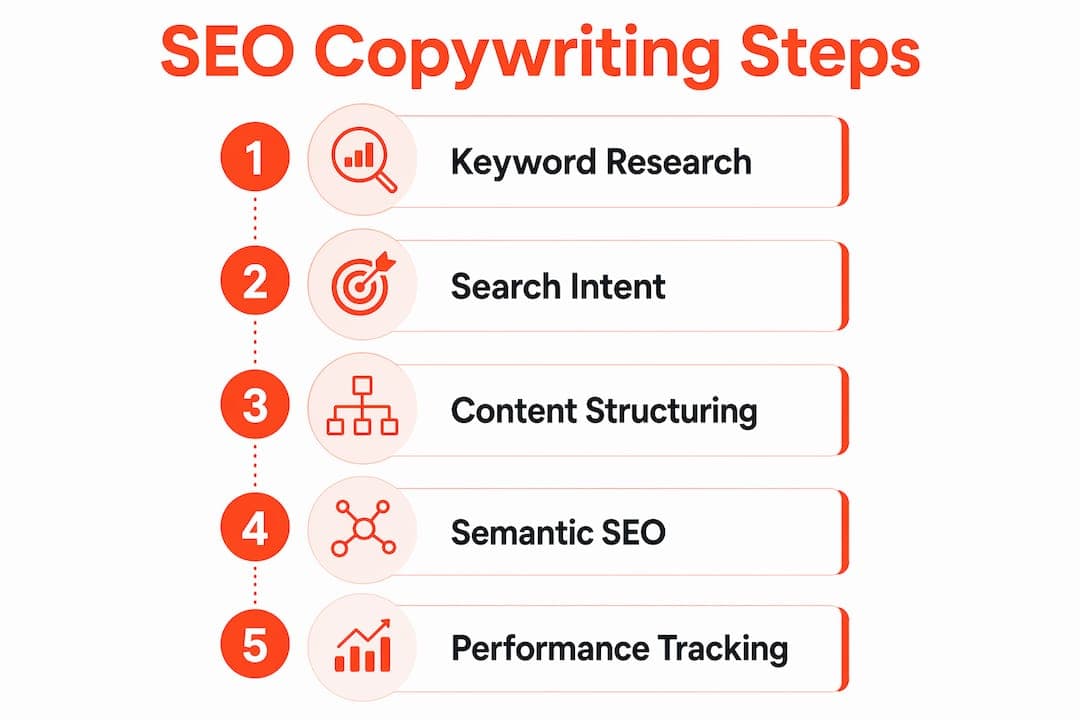
Keyword research is the non-negotiable first step. Before writing a single sentence, you need to identify a primary keyword and a set of ancillary keywords that support topical authority. Targeting ancillary keywords and matching keyword intent are key to ranking for a wider range of search queries. This means one article can capture traffic from dozens of related searches, not just one.
Understanding search intent before you write
Search intent falls into four categories: informational, navigational, commercial, and transactional. Each type demands a different content format. A query like "how to write SEO copy" signals informational intent, which calls for a structured guide with clear steps. A query like "best SEO content platform" signals commercial intent, which calls for comparisons and evidence.

Successful SEO copywriters use rigorous SERP analysis to align content format with the intent Google has already validated. That means studying the top 5 results for your target query before writing. Look at their format, length, heading structure, and the questions they answer. Your job is to do all of that better.
Key tools for SEO content writing
The table below maps the core tool categories to their function in the SEO content writing workflow.
| Tool Category | Primary Function | Typical Use Case |
|---|---|---|
| Keyword planner | Discover search volume and keyword variants | Building primary and ancillary keyword lists |
| SERP analyzer | Study top-ranking content format and structure | Intent alignment before writing |
| Content structure planner | Outline headings and topic clusters | Organizing articles for topical authority |
| Metadata optimization tool | Craft title tags and meta descriptions | Improving click-through rate from search results |
| SEO auditing platform | Identify technical and on-page issues | Post-publish performance checks |
Platforms like Babylovegrowth combine keyword discovery, content planning, and AI SEO auditing in one place, which cuts the time spent switching between tools. For marketing teams managing multiple content streams, that consolidation matters.
Pro Tip: Run a keyword gap analysis before finalizing your topic list. It reveals the queries your site is not ranking for but your niche is actively searching.
How do you structure and write SEO copy that satisfies users and search engines?
Structure is not a formatting preference. It is a ranking signal. Google's crawlers read heading hierarchy to understand what a page covers and how deeply. A well-structured article with logical H1, H2, and H3 headings tells both the algorithm and the reader exactly what to expect.
Follow this sequence when writing SEO copy:
- Build a content outline first. Map your primary keyword to the H1. Assign ancillary keywords and related questions to H2 and H3 headings. This prevents keyword stuffing and creates natural topical coverage.
- Write the introduction with a direct claim. The first sentence should define the topic or state the core finding. Readers and AI citation engines both favor content that delivers the answer immediately.
- Place the primary keyword in the first 100 words. This signals relevance to crawlers without forcing repetition throughout the body.
- Use active voice and short sentences. Subject-verb-object construction keeps reading level accessible and reduces bounce rate.
- Write for scanability. Use bullet points, numbered lists, and short paragraphs of 3–5 sentences. Readers scan before they read, and structure determines whether they stay.
- Close each section with a transition or implication. Do not leave the reader to connect the dots. State what the information means for their situation.
Headlines and meta descriptions significantly impact organic click-through rate. A title that includes the primary keyword and a specific benefit outperforms a generic one every time. For meta descriptions, write 150–160 characters that summarize the page's value and include a soft call to action.
Pro Tip: Write your meta description after the article, not before. You will have a clearer sense of the page's strongest claim, which makes the description more accurate and more compelling.
Semantic SEO is the practice of including related terms, synonyms, and topic-adjacent phrases that signal depth to Google. An article about SEO copywriting techniques should naturally mention SERP analysis, E-E-A-T, keyword intent, and content structure. These terms do not need to be forced. If your content is genuinely comprehensive, they appear on their own.
You can find a detailed breakdown of what makes an SEO article perform in organic search, including structural and semantic requirements, in Babylovegrowth's content library.
What are common mistakes in SEO copywriting and how do you avoid them?
Most underperforming content shares the same set of problems. Recognizing them early saves time and prevents wasted publishing cycles.
- Misreading search intent. Writing a listicle when the SERP shows long-form guides, or writing a guide when the SERP shows product pages, guarantees poor rankings regardless of writing quality.
- Keyword stuffing. Repeating the primary keyword unnaturally signals manipulation to Google's algorithms and makes the copy awkward for readers. Density is not a ranking factor. Relevance is.
- Wrong content length. Ideal content length varies with query type. Competitive informational queries perform best at 1,500–2,500 words. Focused queries may need only 800–1,200 words. Longer is not always better.
- Neglecting metadata. Title tags and meta descriptions are the first thing a searcher sees. Leaving them as auto-generated defaults wastes the click-through opportunity.
- Skipping internal linking. Internal links distribute authority across your site and help Google understand your content structure. Every article should link to at least two related pages.
- Ignoring structured data. Schema markup helps search engines display rich results, which increases visibility without requiring a higher ranking position.
"SEO copywriting success stems from not hoping for rankings but designing content as the clearest and most comprehensive user intent solution. The best-performing pages are built, not written." — cicero.studio
Pro Tip: If an article ranks on page 2 but gets low clicks, the problem is usually the title or meta description, not the content itself. Fix the metadata before rewriting the body.
A useful diagnostic is to read your article as if you had never heard of the topic. If you finish with unanswered questions, so will Google. Fill those gaps before publishing.
How do you measure and optimize SEO copywriting results over time?
Publishing is the beginning of the process, not the end. Continuous testing and updating of SEO copy are necessary to adapt to algorithm changes and shifting user behavior. Content that ranks today can slip in three months if it is not maintained.
Track these metrics after every publish:
- Organic ranking position. Use Google Search Console to monitor where your target keywords land. A position in the top 10 is the baseline goal.
- Click-through rate (CTR). Low CTR on a high-ranking page means the title or meta description is not compelling. Test variations.
- Bounce rate and time on page. High bounce rate signals a mismatch between what the title promised and what the content delivered.
- Conversions. Track form fills, sign-ups, or purchases that originate from organic traffic. This connects SEO effort to business outcomes.
The table below shows which tools cover each metric category.
| Metric | Recommended Tool | Action Trigger |
|---|---|---|
| Organic ranking | Google Search Console | Drop of 3+ positions in 30 days |
| Click-through rate | Google Search Console | CTR below category average |
| Bounce rate | Google Analytics | Rate above 70% for informational content |
| Conversions | Google Analytics | Conversion rate below baseline |
| Technical issues | SEO auditing platform | Any crawl errors or page speed drops |
Interpreting data correctly is as important as collecting it. A drop in ranking after a content update usually means the update changed the page's relevance signal. A drop after no changes usually means a competitor published stronger content. Both require different responses.
A/B testing headlines and introductions is underused in SEO content. Small changes to the first paragraph or the H1 can shift time-on-page meaningfully. Pair that with a content marketing checklist to keep every update systematic and trackable.
Key Takeaways
Effective SEO copywriting requires matching search intent precisely, structuring content for both crawlers and readers, and treating publishing as the start of an ongoing optimization cycle.
| Point | Details |
|---|---|
| Match search intent first | Analyze the top SERP results before writing to align format and depth with what Google already validates. |
| Use E-E-A-T as your quality benchmark | Content must demonstrate experience, expertise, authoritativeness, and trustworthiness to earn top rankings. |
| Structure drives rankings | Logical H1, H2, and H3 hierarchies signal topical depth to crawlers and improve reader retention. |
| Metadata controls click-through rate | Optimized title tags and meta descriptions are the fastest way to increase traffic without changing rankings. |
| Measure and update regularly | Track ranking, CTR, bounce rate, and conversions, then update content before it loses ground to competitors. |
What I've learned writing SEO copy that actually ranks
Most marketers treat SEO copywriting as a writing problem. It is actually a research problem with a writing component. The articles that consistently rank are the ones built on the most thorough pre-writing analysis, not the ones with the most polished prose.
The shift I see in 2026 is that AI-generated summaries in search results are pulling clicks away from pages that only partially answer a query. If your content covers 80% of what a user needs, an AI overview will cover the gap and the user will never visit your page. The only defense is to be the most complete source on the topic.
I have also found that most teams underinvest in the update cycle. They publish, move on, and wonder why rankings plateau. The pages that compound in traffic over time are the ones that get reviewed every quarter, updated with new data, and expanded when competitors publish stronger content. That discipline is rarer than good writing, and it is more valuable.
The other overlooked detail is internal linking. A well-linked article passes authority to newer pages and signals to Google that your site has depth on a topic. Most teams treat internal links as an afterthought. The teams that treat them as a structural element consistently outperform those that do not.
— MEET
How Babylovegrowth supports your SEO copywriting workflow
Babylovegrowth is built for marketing professionals who need to move from keyword research to published, optimized content without losing time to manual processes.
The platform's keyword discovery tool surfaces hidden keyword opportunities that standard planners miss, giving your content a head start on topical authority. The AI SEO audit runs technical checks automatically, so you catch metadata gaps, crawl errors, and structured data issues before they cost you rankings. For teams managing ongoing content programs, Babylovegrowth's 30-day content plans and automatic internal linking remove the guesswork from scaling SEO copy. The result is a content operation that produces consistently well-structured, well-targeted articles without requiring a full-time SEO specialist on every project.
FAQ
What is SEO copywriting?
SEO copywriting is the practice of writing web content that satisfies both search engine algorithms and human readers to improve organic rankings and drive conversions. It combines keyword research, content structure, metadata optimization, and persuasive writing.
How long should SEO copy be?
Content length depends on query type. Competitive informational queries perform best at 1,500–2,500 words, while focused queries often succeed at 800–1,200 words. The goal is to be more complete than the competition, not simply longer.
What is E-E-A-T and why does it matter for SEO copy?
E-E-A-T stands for experience, expertise, authoritativeness, and trustworthiness. Google uses these signals to evaluate content quality, and pages that demonstrate all four consistently rank higher than those that do not.
How often should I update SEO content?
Review and update published content at least once per quarter. Ranking drops, new competitor content, and algorithm updates are the primary triggers for a content refresh.
What is the biggest mistake in SEO copywriting?
Misreading search intent is the most common and costly mistake. Writing the wrong content format for a query, regardless of writing quality, prevents the page from ranking because it does not match what Google has already validated as the correct answer type.