Natural Backlinks: Complete Guide for Organic SEO


Did you know that over 90 percent of top-ranking Google pages receive backlinks from other websites? Natural backlinks act like digital votes of confidence, helping your content stand out in crowded search results. Understanding how these links work can make a real difference in how much authority search engines attribute to your website, giving you an edge over competitors chasing the same audience.
Table of Contents
- What Are Natural Backlinks? Core Definition
- Types of Natural Backlinks in SEO
- How Natural Backlinks Improve Rankings
- Earning Natural Backlinks: Effective Strategies
- Risks, Mistakes, and Unnatural Link Penalties
- Natural Backlinks vs. Other Link Types
Key Takeaways
| Point | Details |
|---|---|
| Definition of Natural Backlinks | Natural backlinks are unpaid, organic links earned through high-quality content that others cite voluntarily, serving as trust signals for search engines. |
| Types of Natural Backlinks | The primary types are editorial (highest value), guest post (original contributions), and social media links, each contributing differently to SEO. |
| Impact on Rankings | Natural backlinks enhance search rankings by boosting domain authority and demonstrating content value, acting as digital endorsements. |
| Best Practices for Earning | Create exceptional, informative content that addresses audience needs, and avoid manipulative link-building practices to maintain search engine credibility. |
What Are Natural Backlinks? Core Definition
Natural backlinks are organic, unpaid hyperlinks that other websites voluntarily create to reference your content because they find it genuinely valuable. Organic linking represents the gold standard in search engine optimization, where high-quality content earns recognition through authentic recommendations across the web. According to research from Wikipedia, these links emerge when websites independently determine your content provides meaningful insights or solutions.
Unlike manipulative link-building strategies, natural backlinks occur spontaneously when content demonstrates exceptional quality, research depth, or unique perspective. Search engines like Google recognize these links as powerful trust signals, considering them more credible than artificially generated connections. A natural backlink suggests that independent web resources find your material authoritative enough to cite voluntarily.

The core characteristics of natural backlinks include:
- Originate without direct solicitation
- Appear in contextually relevant content
- Reflect genuine editorial choice
- Stem from high-quality, informative material
Exploring more strategic approaches to generating natural backlinks? Check out our guide on best link building strategies for 2025 to understand how compelling content can attract organic references.
Types of Natural Backlinks in SEO
Natural backlinks manifest in several distinct categories, each offering unique value to your SEO strategy. Editorial backlinks represent the most prestigious type, where authoritative websites voluntarily link to your content based on its inherent quality and relevance. According to research from SEO for Universities, these backlinks emerge when other websites recognize your content as a valuable reference point.
Three primary types of natural backlinks dominate the SEO landscape:
Here's a comparison of the primary types of natural backlinks:
| Backlink Type | How It's Earned | Typical Source | SEO Value |
|---|---|---|---|
| Editorial Backlinks | Cited spontaneously for quality or insight | Authoritative websites | Highest |
| Guest Post Backlinks | Contributed original content to reputable site | Industry blogs<br>Media sites | High |
| Social Media Backlinks | Shared and linked via social channels | Facebook<br>Twitter<br>LinkedIn | Moderate to High |
- Editorial Backlinks: Spontaneous links from credible websites citing your content as a reliable source
- Guest Post Backlinks: Links acquired through contributing high-quality, original content to reputable websites
- Social Media Backlinks: Generated when your content is shared and linked across social platforms
Understanding the nuanced differences between these backlink types can significantly enhance your organic search strategy.
Each category contributes differently to your website's credibility and search engine visibility.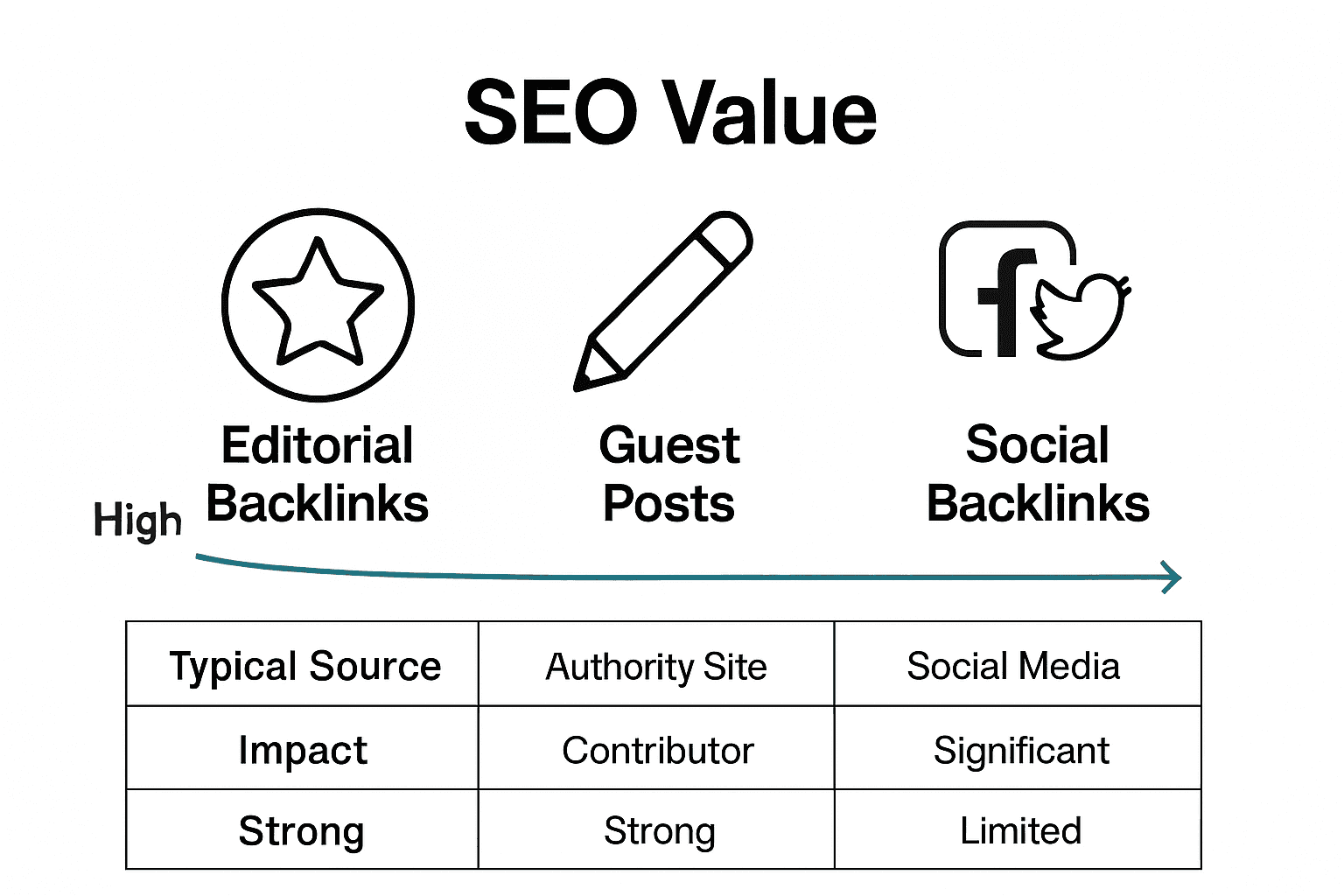
How Natural Backlinks Improve Rankings
Natural backlinks serve as critical trust signals that dramatically enhance a website's search engine rankings. According to Wikipedia, search engines like Google use the quantity, quality, and relevance of backlinks to estimate a web page's importance. These organic links act as digital endorsements, telling search algorithms that your content is valuable and worth displaying prominently in search results.
Domain authority and content credibility are directly influenced by the natural backlinks you accumulate. Search engines interpret these voluntary links as third-party validation, essentially treating them as recommendations from independent sources. When reputable websites link to your content, it signals to search algorithms that your material is trustworthy and information-rich.
Key ways natural backlinks improve search rankings include:
- Increasing overall website domain authority
- Enhancing content perceived relevance
- Providing contextual signals to search algorithms
- Demonstrating genuine content value beyond self-promotion
Interested in understanding how backlinks impact your SEO strategy? Dive deeper into the mechanics of search rankings with our guide on Google page ranking to unpack the intricate world of search engine optimization.
Earning Natural Backlinks: Effective Strategies
Creating exceptional content remains the cornerstone of earning natural backlinks. According to Wikipedia, successful organic linking requires developing unique and informative content that provides genuine value to others. This means going beyond surface-level information and crafting in-depth, original insights that other websites will want to reference and share.
Content quality is the primary driver of natural backlink acquisition. Websites are more likely to link to resources that offer comprehensive analysis, original research, or solve specific problems in unique ways. Think of your content as a valuable resource that other publishers would be proud to reference, not just another generic piece floating in the digital ecosystem.
Key strategies for attracting natural backlinks include:
- Producing original research and data-driven content
- Creating comprehensive, authoritative guides
- Developing interactive or multimedia content
- Addressing complex industry challenges with innovative solutions
Want to dive deeper into building a robust backlink strategy? Our guide on how to get backlinks for SEO success provides actionable insights to elevate your link-building approach.
Risks, Mistakes, and Unnatural Link Penalties
Search engines have become increasingly sophisticated in detecting manipulative link-building practices. According to Wikipedia, engaging in link spam or artificial link schemes can trigger severe penalties from search engines like Google. The infamous Penguin update specifically targeted websites using manipulative tactics to artificially inflate their search rankings.
Unnatural link penalties can devastate a website's online visibility. These penalties range from subtle ranking drops to complete removal from search results. Common red flags that trigger penalties include sudden link volume spikes, links from irrelevant or low-quality websites, and repetitive anchor text that appears engineered rather than organic.
Key risks to avoid in your backlink strategy:
- Purchasing links from link farms
- Using automated link-building tools
- Creating excessive reciprocal link exchanges
- Implementing large-scale guest posting solely for links
- Generating links through comment spam
Curious about maintaining a clean, penalty-free link profile? Are internal links good for SEO provides insights into building a sustainable, search-engine-friendly linking strategy that keeps your website in good standing.
Natural Backlinks vs. Other Link Types
Natural backlinks stand apart from other link types through their authentic, voluntary nature. According to research from SignalBoy, these links are earned organically when websites voluntarily link to valuable content, representing genuine trust and relevance unlike artificially generated connections.
Link attributes play a crucial role in distinguishing backlink types. While dofollow links pass full SEO value and nofollow links prevent ranking signals, natural backlinks are typically high-quality dofollow links that search engines view as authentic endorsements. Artificially generated links, such as those from link exchanges or paid placements, lack the contextual credibility of organic references.
Key differences between natural and other link types include:
- Origin of the link (voluntary vs. manufactured)
- Contextual relevance
- Search engine perception
- Long-term SEO impact
- Authenticity of the endorsement
Want to dive deeper into understanding link strategies? Our guide on the importance of backlinks provides comprehensive insights into building a robust, search-engine-friendly linking approach.
Unlock the Power of Natural Backlinks with AI-Driven SEO Solutions
Struggling to earn authentic, high-quality backlinks that truly boost your search rankings? The article highlights how natural backlinks require valuable, well-crafted content and genuine editorial interest. You want to grow your website's authority without risking penalties from unnatural link strategies or wasting time on complex SEO tactics. Our platform understands these challenges and offers a streamlined, AI-powered approach to help you create content that attracts organic endorsements and amplifies your domain's trust signals.
Take control of your backlink strategy today by leveraging Babylovegrowth.ai, your all-in-one solution for scaling SEO through AI-generated articles and a collaborative backlink exchange ecosystem. Experience detailed business analysis, a personalized 30-day content plan, and services designed to rank high on Google and ChatGPT naturally. To deepen your grasp of how backlinks influence your SEO success, explore our guide on how to get backlinks for SEO success and strengthen your strategy with insights from our importance of backlinks guide. Start your journey now and beat the competition by growing your organic traffic the smart way.
Frequently Asked Questions
What are natural backlinks?
Natural backlinks are organic, unpaid links that other websites create to reference your content because they find it valuable. They are a sign of trust and authority in the eyes of search engines.
How do natural backlinks improve SEO rankings?
Natural backlinks enhance SEO rankings by acting as trust signals. They indicate to search engines that your content is valuable and credible, which can lead to increased visibility in search results.
What types of natural backlinks are there?
The three primary types of natural backlinks are editorial backlinks, guest post backlinks, and social media backlinks. Each type contributes uniquely to your site's credibility and search engine visibility.
How can I earn natural backlinks?
To earn natural backlinks, focus on creating high-quality, unique, and informative content. Strategies include producing original research, comprehensive guides, multimedia content, and addressing complex industry challenges.