Scalable SEO – Why It’s Vital for Agency Growth


Managing SEO for a handful of clients feels manageable until growth multiplies your workload overnight. For digital marketing agency owners and SEO specialists, scaling efficiently is not just about doing more—it is about building smarter systems that deliver stronger results with the same resources. By investing in automation and templated approaches, agencies can evolve from manual project work to repeatable systems that fuel high-impact success without burning out their team.
Table of Contents
- Defining Scalable SEO For Modern Agencies
- Key Features And Types Of Scalable SEO
- How Automation Drives SEO Scalability
- Real-World Benefits For Agencies And Clients
- Common Challenges And Mistakes To Avoid
- Comparing Scalable SEO With Traditional Models
Key Takeaways
| Point | Details |
|---|---|
| Scalable SEO Transfers Projects into Systems | Transform SEO campaigns into scalable systems to amplify results without a proportional increase in resources. |
| Emphasize Automation and Templates | Implement automation and standardize processes to enhance productivity and efficiency. |
| Focus on Exception Management | Use automated exception detection to catch performance issues before clients notice, ensuring continuous improvement. |
| Balance Quality and Quantity | Maintain high-quality output while increasing content volume by leveraging automation and standardized workflows. |
Defining scalable SEO for modern agencies
Scalable SEO isn't about doing more of the same thing. It's about transforming your campaigns into systems that produce exponentially better results without requiring a proportional increase in resources or headcount. Most agencies treat SEO as a collection of individual projects. Scalable SEO treats it as an operating system.
At its core, scalable SEO means building processes that amplify your efforts. When you're managing campaigns for five clients, manual keyword research works fine. When you're managing fifty, it collapses. That's where the framework breaks down. Transforming campaigns into systems that compound your results without multiplying your workload is the entire goal here.
Think of it this way. Your agency grows through two paths: hiring more people or automating more work. Hiring solves short-term capacity problems but creates long-term margin problems. You're paying salaries that scale with revenue. Automation, on the other hand, gets cheaper the more you use it. A content template that takes three hours to create benefits you for years. That's the math of scalable SEO.
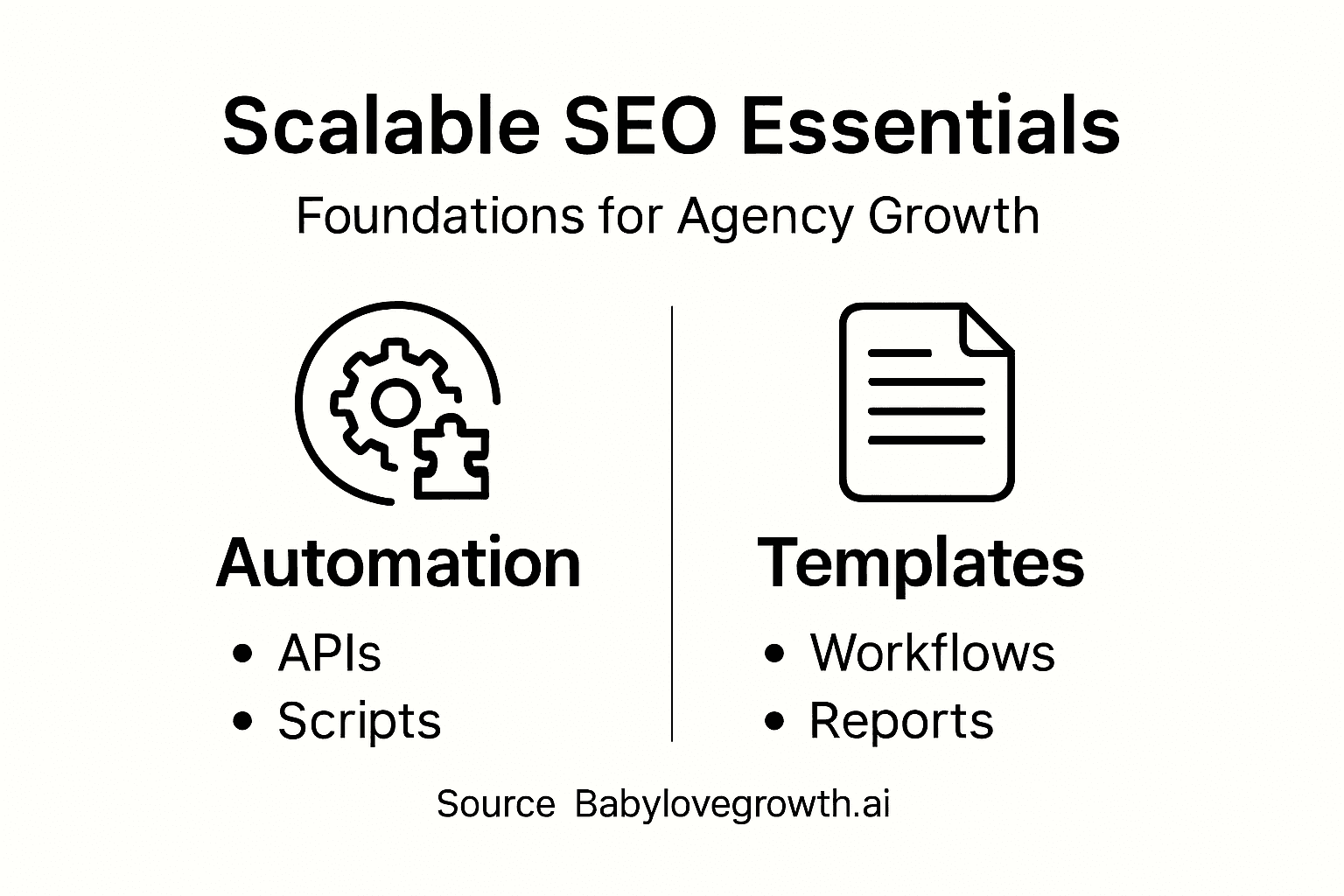
Modern agencies need three foundational elements. First, automation and templated approaches that standardize your best practices. Second, organizational alignment where every team member understands the system and follows it. Third, a ruthless focus on high-impact actions that move the needle instead of busywork that fills time.
The technical backbone matters too. APIs and automation infrastructure allow your team to handle increased content production and campaign management without burnout. You're not hiring five more SEO specialists. You're building tools that five specialists can manage like twenty.
Pro tip: Start by documenting your top-performing SEO processes as templates today, then identify which steps can be automated using tools that integrate with your workflow rather than requiring manual intervention.
Key features and types of scalable SEO
Scalable SEO breaks down into distinct features that separate agencies managing ten clients from those managing one hundred. The difference isn't in the individual tactics. It's in the architecture underneath them.

Automation sits at the core. You're replacing manual tasks with systems that run continuously. Keyword research automation, content scheduling, rank tracking, and technical audits all happen on timelines you set once and then largely forget about. SEO automation with AI amplifies your team's output without requiring proportional increases in headcount. One analyst can oversee what previously required three.
Modular templates are your second pillar. Instead of building custom SEO strategies from scratch for each client, you create proven frameworks that adapt to different industries and business sizes. These templates standardize your best practices across all accounts. When something works for Client A, Client B and Client C benefit immediately through template updates.
Idempotent processes matter more than most agencies realize. An idempotent process produces the same result regardless of how many times it runs. This means your systems remain reliable at scale. Whether you're managing fifty campaigns or five hundred, the same automation produces consistent outcomes. Idempotent processes make SEO operations repeatable and manageable at massive scale, eliminating the chaos that comes from manual interventions.
Performance awareness keeps everything running smoothly. You're not just chasing rankings. You're monitoring page speed, Core Web Vitals compliance, and other technical markers that signal both user experience and search visibility. These metrics feed back into your optimization cycles automatically.
Architecture design for global delivery rounds out the core features. Your systems should support rapid iteration across multiple markets and regions without creating bottlenecks. Observability tools help you detect regressions before clients notice them, letting you catch problems at scale before they compound.
Pro tip: Audit your current workflows this week and identify three manual tasks your team repeats weekly; these are your highest-priority automation candidates that will free up hours monthly.
How automation drives SEO scalability
Automation is the difference between an agency that grows linearly and one that grows exponentially. Without it, you hit a ceiling. You've got ten people doing ten clients' worth of work. Add another client, and you need another person. That math breaks fast.
With automation, the equation flips. You add a new client and your systems absorb the workload automatically. Keyword research runs nightly without human intervention. Content calendars populate themselves based on performance data. Rank tracking happens continuously across thousands of keywords. Your team spends time on strategy and client relationships instead of repetitive tasks.
The time multiplication effect is where automation creates real scalability. A template that takes four hours to build gets used for fifty clients. That's 200 hours of work compressed into four. Each new client benefits immediately from systems already proven effective. Automating SEO processes eliminates the manual bottlenecks that normally constrain agency growth.
Consistency scales differently with automation too. When humans handle everything, quality fluctuates based on who's working and how tired they are. Automation produces identical results every single time. Your tenth client gets the same quality output as your first. That consistency builds trust and reduces revision cycles.
Cost efficiency compounds over time. The investment in automation tools costs the same whether you manage ten accounts or one hundred. Your cost per client drops dramatically as you scale. Competitors still operating manually can't match your margins or compete on pricing without destroying profitability.
Data-driven decision making accelerates with automation too. Automated systems collect, organize, and surface insights continuously. You spot trends faster. You identify underperforming keywords quicker. You scale winners across accounts in days instead of weeks. This feedback loop means your strategies improve constantly.
The real magic happens when automation handles exception detection. Your systems flag problems automatically. A page drops in rankings? You're notified. Core Web Vitals regress? The system alerts you. You respond to exceptions rather than searching for them.
Below is a summary of automation's business impacts in a scalable SEO agency:
| Automation Area | Impact on Productivity | Impact on Profitability |
|---|---|---|
| Keyword Research | Completes tasks in minutes, not hours | Reduces labor costs significantly |
| Content Scheduling | Ensures steady publishing cadence | Lowers need for manual oversight |
| Rank Tracking | Monitors thousands of terms 24/7 | Enables data-driven decisions quickly |
| Reporting | Frees 8-12 labor hours weekly | Directly increases agency margins |
| Exception Alerts | Instantly detects performance drops | Protects client retention and reputation |
Pro tip: Start by automating your monthly reporting process this month; this single step typically frees up 8-12 hours weekly and creates a foundation for expanding automation across other workflows.
Real-world benefits for agencies and clients
Scalable SEO isn't theoretical. The numbers prove it works. Agencies that implement scalable frameworks see concrete results that transform their business fundamentals and client outcomes simultaneously.
Organic traffic growth accelerates dramatically. Real case studies show a 167% rise in organic traffic when agencies adopt automation and standardized workflows. That's not incremental improvement. That's business transformation. Your clients see their visibility explode across search results. Their lead generation pipeline fills faster. Revenue follows.
Content production capacity multiplies without adding headcount. Teams achieve a 10x jump in content production through automation and templates. One person produces what previously required ten. Your agency suddenly has spare capacity to take on new clients or deepen work for existing ones.
Resource optimization directly impacts agency profitability. You're not paying ten people to do the work of one. Your margins expand while client costs stay competitive. This creates a defensive moat. Competitors operating manually can't compete on pricing without destroying their business.
Clients experience consistency they've never seen before. Manual work produces variable results. Automated systems produce identical quality every single time. A client's SEO strategy executes flawlessly month after month. They stop worrying about whether work is getting done. It is. Automatically.
Retention improves because results speak loudly. When clients see predictable 167% traffic increases instead of hoping for marginal gains, they stay. They refer. They become advocates. Your agency builds reputation on repeatability rather than luck.
Long-term sustainable growth replaces the burnout cycle. Your team stops working nights and weekends chasing manual tasks. They work on strategy. They think bigger. They stay longer. Turnover drops. Expertise accumulates. Your agency becomes smarter and stronger over time.
Pro tip: Track your current client results against the 167% benchmark for six months; this data becomes your strongest sales tool when pitching prospects and demonstrates scalable SEO's impact before they sign.
Common challenges and mistakes to avoid
Scalable SEO fails for predictable reasons. Most agencies don't stumble because they lack effort or talent. They stumble because they repeat the same avoidable mistakes that sabotage growth from the start.
The biggest error is chasing volume without strategy. Agencies pump out content expecting quantity alone to drive rankings and traffic. Assuming more content volume drives results ignores the fundamental truth: bad content at scale is just amplified failure. You're burning resources creating noise instead of signal. Your clients see activity but no results.
Neglecting keyword strategy creates the foundation for collapse. Many agencies skip rigorous keyword research and jump straight to content creation. They miss high-value opportunities hiding in long-tail keywords. They target generic phrases everyone competes for instead of specific queries with intent and lower competition. Ignoring long-tail keywords means leaving money on the table while chasing harder battles.
Manual processes become the growth ceiling. Agencies that rely too heavily on manual work can't scale beyond their team's capacity. You hire more people but margins shrink. Burnout increases. Quality suffers. The math never works. Clear workflows paired with automation separate sustainable agencies from ones that plateau.
Balancing quality with quantity separates winners from burnouts. The trap is believing these are enemies. They're not. Automation maintains quality while increasing output. Templates ensure consistency. Process standardization protects excellence as you scale. Without this balance, you either produce mediocre content quickly or excellent content slowly.
Waiting too long to invest in automation delays growth unnecessarily. Agencies often automate only after they're drowning in manual work. By then, they've lost momentum and burned out their best people. Automation should happen early, when you have bandwidth to implement properly. The cost now is small. The cost of waiting is massive.
Pro tip: Audit your keyword strategy this week and identify five long-tail keyword clusters your competitors miss; implement these into your content calendar before scaling volume.
Comparing scalable SEO with traditional models
Traditional SEO and scalable SEO look similar on the surface. Both involve keywords, content, and rankings. But underneath, they operate on completely different principles. Understanding the distinction determines whether your agency grows or plateaus.
Traditional SEO is project based. You take on a client, run a campaign, deliver results, then move to the next project. Each client requires custom strategy, custom templates, and custom execution. Your team works hard on each account individually. This works fine when you have five clients. It breaks at fifty.
Scalable SEO is system based. You build processes once that work across unlimited clients. Templates adapt to different industries. Automation handles repetitive work. Your team scales their impact without scaling headcount proportionally. Ten people manage what previously required a hundred.
Resource efficiency shows the clearest difference. Traditional agencies need one person per three to five clients to maintain quality. Scalable agencies support one person per twenty to thirty clients through automation and templates. Your cost structure becomes sustainable instead of a constant margin squeeze.
Growth trajectory diverges rapidly. Traditional agencies grow linearly. You add clients, you hire people. Revenue increases but so do costs. Margins stay flat or shrink. Scalable agencies grow exponentially. You add clients but don't hire proportionally. Your cost per client drops. Revenue accelerates while expenses decelerate. That's where real profitability lives.
Client outcomes improve with scalable models too. Traditional approaches mean clients compete for your attention. Your best person manages ten accounts. Average person manages ten accounts. New person manages five accounts. Quality varies wildly. Scalable systems mean every client gets identical process quality executed identically whether they're your first or your thousandth.
Here's how scalable SEO compares with traditional SEO in key areas:
| Aspect | Traditional SEO | Scalable SEO |
|---|---|---|
| Campaign Approach | Project-based, custom per client | System-based, templates for all clients |
| Team Capacity | 1 person per 3-5 clients | 1 person per 20-30 clients |
| Growth Pattern | Linear growth, adds headcount | Exponential growth, minimal new hires |
| Quality Consistency | Varies between clients | Identical outcomes for every client |
| Cost Efficiency | Margins shrink as you scale | Margins grow with automation |
| Speed of Optimization | Weeks to scale changes | Changes rolled out in days |
The competitive advantage compounds over time. Traditional agencies stay tactical. Scalable agencies think strategically. They optimize systems instead of optimizing individual campaigns. They discover what works once and replicate it infinitely. That creates an unfair advantage competitors can't match.
Pro tip: Choose three of your highest-performing client campaigns and document their exact process this month; these become your scalable template foundation that works across all new accounts.
Unlock Seamless Growth with Scalable SEO Automation
Scaling SEO without burning out your team or sacrificing quality is challenging. This article highlights how traditional manual processes create bottlenecks and margin pressures while scalable SEO demands automation, templated frameworks, and measurable consistency. If your agency is struggling to keep pace with client demands or looking to multiply organic traffic efficiently, embracing AI-powered solutions is the answer. Babylovegrowth.ai offers a comprehensive platform built for exactly that purpose, tackling keyword research, content scheduling, backlink building, and technical audits with intelligent automation designed to boost productivity without proportional headcount increases.
Transform your agency’s SEO operations today by leveraging Babylovegrowth.ai. Explore how our automated content plans and daily SEO articles help your team deliver consistent, high-impact results at scale. Visit Babylovegrowth.ai now to experience exponential growth through actionable AI-driven SEO workflows that turn your scaling challenges into lasting competitive advantages.
Frequently Asked Questions
What is scalable SEO?
Scalable SEO refers to transforming SEO campaigns into systems that allow agencies to achieve greater results without a significant increase in resources or manpower. It focuses on automation, standardized processes, and optimizing workflows to enhance performance across multiple clients.
How does automation contribute to scalable SEO?
Automation minimizes manual tasks, allowing agencies to perform keyword research, content scheduling, and rank tracking more efficiently. It helps increase productivity, consistency, and profitability by enabling teams to focus on strategy and client relationships instead of repetitive actions.
What are the key features of a scalable SEO strategy?
Key features include automation, modular templates that standardize best practices, idempotent processes for consistency, performance awareness to monitor metrics, and architecture that supports global delivery without bottlenecks.
Why is it important for agencies to adopt scalable SEO frameworks?
Adopting scalable SEO frameworks is vital for agencies because it drives organic traffic growth, increases content production capacity, enhances resource optimization, improves client retention, and fosters long-term sustainable growth without overwhelming the team.