Impact of Voice Search on Modern SEO Strategies


Many marketers still operate under misconceptions about how voice search works, especially when targeting customers in the United States or Canada. Spoken queries are not just typed searches read aloud. According to Oxford Academic research, users phrase vocalized queries more specifically and thoughtfully, leading to higher satisfaction with voice results compared to typed searches. This article breaks down the real mechanics of voice search, exposes common myths, and shows how you can capture traffic from customers ready to act.
Table of Contents
- Voice Search Explained And Common Myths
- Distinct Types Of Voice Search Devices
- How Voice Search Algorithms Process Queries
- Optimizing Content And SEO For Voice Search
- Potential Risks And Challenges For Businesses
Key Takeaways
| Point | Details |
|---|---|
| Shift in User Behavior | Voice search queries are more conversational and specific, necessitating an evolution in content strategy beyond simple keyword optimization. |
| Device-Specific Optimization | Different devices like smartphones and smart speakers require tailored optimization strategies to effectively capture voice search traffic. |
| Importance of Schema Markup | Implementing structured data is crucial as it helps voice search algorithms understand and present your content accurately. |
| Risk Awareness | Businesses should be mindful of privacy, security, and data accuracy challenges presented by voice search technology to safeguard their reputation and operations. |
Voice Search Explained and Common Myths
Voice search has fundamentally changed how people interact with search engines, yet most marketers still operate under outdated assumptions about how it works. When someone speaks a query instead of typing it, they're not just saying their typed search aloud. Research into vocalized query behavior shows that users phrase voice searches differently, often more conversationally and with greater specificity. They think through their questions more carefully because speaking requires more cognitive effort than typing a quick keyword phrase. This shift means your content strategy needs to evolve beyond optimizing for three-word keywords.
Most of the myths surrounding voice search stem from its relative newness in the digital marketing space. A common misconception is that voice search delivers lower-quality results or that users find it less helpful than typed search. This simply isn't accurate. When voice search behavior in the U.S. market was analyzed through the lens of user satisfaction and acceptance, researchers found that people engage with voice technology thoughtfully and report higher satisfaction with results. Users aren't treating voice search as a gimmick or novelty. They're using it as a legitimate search method that fits their lifestyle, especially for local queries, quick information needs, and hands-free situations like driving or cooking. For North American SMBs, this represents a significant opportunity because voice searchers often have immediate intent. They're looking for solutions right now, not browsing abstractly.
Another persistent myth is that voice search optimization requires completely separate strategies from traditional SEO. The reality is more nuanced. Voice search success builds on solid SEO fundamentals while adding specific refinements. Your existing content about your products, services, and industry expertise still matters. What changes is how you structure and present that information. Voice searches tend to be question-based, longer, and more natural than typed queries. Someone typing might search "best CRM for small business," while a voice searcher might ask "What CRM should I use if I have five employees and run a marketing agency?" Your content needs to answer these specific, conversational questions. This doesn't mean abandoning keyword research or technical SEO. It means extending those practices to capture how real humans speak when they're searching.
The idea that voice search will completely replace typed search is also overblown. People will continue typing searches, especially at work, in public spaces, or when searching for complex information. Voice search is complementary, not a replacement. What's changing is that voice now represents a meaningful percentage of total searches, particularly in voice-enabled device ownership among North American consumers. Your SMB might capture voice search traffic you don't currently know you're missing. Consider that someone asking their smart speaker "where can I get a same-day roof inspection near me" could be a local contractor looking for your services. That query might never appear in your typed search analytics.
Pro tip: Start by analyzing your customer service calls and emails to find the exact questions people ask naturally. Adapt that conversational language into your web content, FAQs, and service pages to capture voice search traffic that your current keyword-focused content might be missing.
Distinct Types of Voice Search Devices
Voice search doesn't happen on a single device type. Your customers are searching across smartphones, smart speakers, wearables, and even in-car systems. Each device creates different optimization opportunities because they serve different contexts and user needs. Understanding where your audience is searching matters more than ever for targeting voice queries effectively.
Smartphones remain the most common voice search device, and this makes sense given that most North American adults have one in their pocket. When someone uses voice search on their phone, they're often in motion, multitasking, or searching for immediate solutions. They might be looking for a plumber while standing in their basement with a pipe leak, or searching for your restaurant while already in their car. Virtual voice assistants on smartphones vary by platform. Apple Siri, Google Assistant, and other systems have different capabilities and integration depths. Smartphone voice searches tend to be more specific and action-oriented than smart speaker searches because users are already holding their device and can quickly interact with results.

Smart speakers like Amazon Echo, Google Home, and Apple HomePod represent the second major category, and they're growing rapidly in North American households. These devices serve a different purpose. Someone asking their smart speaker a question while cooking dinner or getting ready in the morning isn't planning to click through to a website immediately. They want a quick answer, a recommendation, or to complete a simple task like setting a timer or playing music. Smart speaker voice searches tend to be more informational and general. Your local services business needs to understand that a smart speaker user asking "Who has good reviews for plumbing services near me" might never see your website in that moment. They might get a voice answer with one recommendation and that's it. This means your business information, reviews, and local SEO signals need to be perfect because the competition for that single voice answer is intense.
Wearables and connected devices represent a smaller but growing segment of voice search traffic. Smartwatches, fitness trackers, and other devices enable quick voice queries for directions, weather, reminders, and quick information checks. Automotive systems deserve special attention too. Voice search in cars is increasing dramatically because hands-free searches are the only safe option while driving. Comparative analysis across voice recognition technologies shows that each device category presents unique technological challenges and user satisfaction patterns.
The practical takeaway is that you can't apply the same voice search optimization strategy across all device types. Smart speaker optimization focuses heavily on getting featured in Google local results and knowledge panels, since those are what voice assistants read aloud. Smartphone optimization requires conversational keyword targeting and quick answers because users can interact with multiple results. In-car voice search optimization matters for local queries, directions, and quick business information. Your content strategy needs to account for these differences. Someone optimizing only for typed search or traditional SEO is missing traffic across all these devices simultaneously.
Here's how key voice search devices differ in context and optimization priorities:
| Device Type | Typical User Scenario | Optimization Focus |
|---|---|---|
| Smartphone | On-the-go, multitasking | Conversational keywords, quick answers |
| Smart Speaker | At home, hands-free | Local listings, knowledge panels |
| Wearable | Fast info, directions | Short queries, location accuracy |
| In-Car System | Driving, navigation | Accurate business info, directions |
Pro tip: Audit your Google Business Profile and schema markup immediately, since smart speakers and voice assistants pull heavily from this data to answer voice queries. Ensure your business category is accurate, your hours are current, and your phone number is prominently displayed, as these elements directly impact voice search visibility.
How Voice Search Algorithms Process Queries
Voice search algorithms operate completely differently from the keyword matching systems that powered search for decades. When someone speaks a query, the algorithm doesn't simply transcribe their words and run them through the same ranking system used for typed searches. Instead, it processes that voice input through multiple sophisticated layers designed specifically to understand conversational language, context, and intent. Understanding this process helps explain why your existing SEO strategy might miss voice search opportunities entirely.
The journey from voice to results happens in stages. First, the system converts your customer's spoken words into text through speech recognition technology. This isn't perfect, and accents, background noise, and unclear pronunciation create challenges. But modern systems handle this remarkably well. Next comes natural language processing (NLP), where the algorithm moves beyond simply understanding individual words. It analyzes grammatical structure, identifies the actual question being asked, and understands what the person truly wants. When someone says "What's the best sushi place near me that's open late," the algorithm recognizes this as a local intent query with specific criteria rather than just matching keywords. This contextual understanding is where voice search fundamentally differs from typed search. Voice search algorithms process natural conversational queries through semantic understanding and machine learning, considering not just what was said but why someone said it.
Context awareness adds another layer of complexity. Voice search algorithms know your location, your search history, the device you're using, and even the time of day. All of this information feeds into what results get returned. Someone asking "What's open near me" at 10 PM gets different results than the same question at 10 AM because the algorithm understands restaurant hours and context. This is why a small local business in Denver gets ranked differently for voice searches than that same search in Phoenix. The algorithm also factors in user behavior patterns. If you frequently ask about coffee shops, your voice search results for casual location queries shift toward coffee-related businesses. This personalization makes voice search results strikingly different from typed search results for the same query.
Machine learning ranking mechanisms then determine which results to return. Advanced speech recognition, NLP, and machine learning combine to adapt rankings specifically for conversational queries. The algorithm ranks webpages not just by traditional signals like backlinks and page authority, but by how directly and clearly they answer the specific question asked. Featured snippets matter exponentially more for voice search because voice assistants often read the top snippet aloud as the answer. Position zero isn't just nice to have anymore. For voice searchers, it's frequently the only result they hear. Your content needs to be structured to win featured snippets by providing clear, concise answers to specific questions.
Structured data becomes critical at this stage. Schema markup tells search engines what information your content contains. When you properly mark up your business hours, phone number, customer reviews, and services with schema, the voice search algorithm can extract and present that information confidently. Without schema markup, the algorithm has to guess and interpret your content, which creates errors and missed opportunities. This is why so many small businesses lose voice search traffic without realizing it. They optimize their content for readability and keyword targeting but never implement the structured data that voice algorithms depend on.
The practical implication for your SEO strategy is significant. Voice optimization requires answering specific questions concisely, appearing in featured snippets, implementing schema markup for your business information, and building content around conversational phrases and long-tail keywords. Your existing keyword research might target "best plumber" but voice search targets "best plumber for emergency repairs in my area." Your content structure needs to match how people speak and ask questions, not just how they type.
Pro tip: Start by identifying the top 20 questions your customers actually ask your sales team or support staff, then create dedicated content sections that answer each question in 40-60 words with a clear statement upfront, since voice algorithms prioritize direct, concise answers for featured snippet selection.
Optimizing Content and SEO for Voice Search
Optimizing for voice search requires a fundamentally different approach than traditional SEO. Your keyword strategy, content structure, and technical implementation all need adjustments to capture voice search traffic. The good news is that these changes also benefit your overall SEO performance because they align with how Google has been pushing the entire industry for years: toward user intent and natural language.
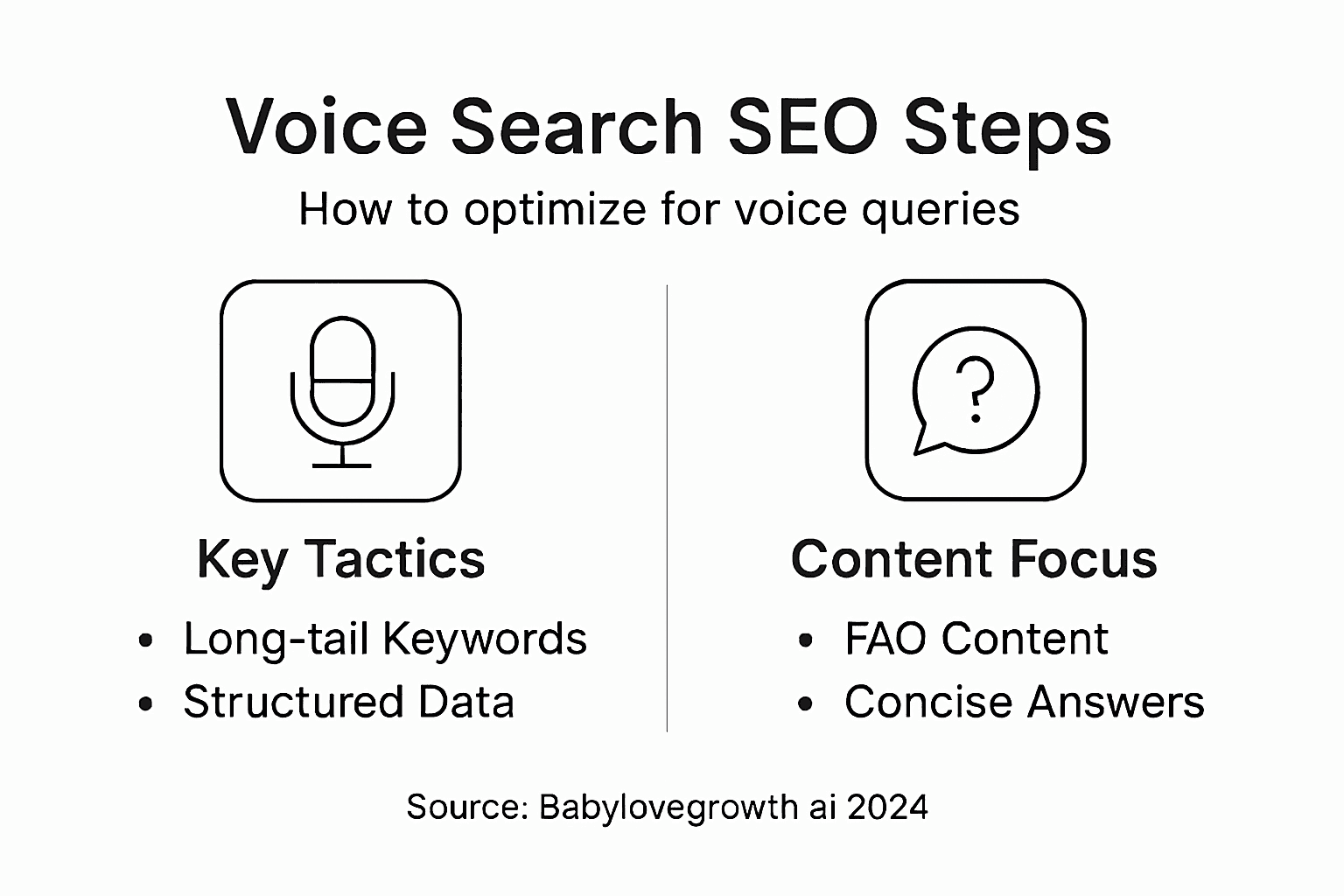
Start with keyword strategy adjustments. Voice searches are longer and more conversational than typed searches. Someone typing searches "best Italian restaurant downtown" but someone using voice search asks "What's the best Italian restaurant near me that has outdoor seating?" This shift means your keyword targeting needs to include long-tail, question-based phrases that match natural speech patterns. Instead of optimizing for "plumbing services," target "how do I fix a leaky kitchen faucet" and "emergency plumbing services near me." Use long-tail keywords that mimic natural speech patterns when researching and structuring your content. Create FAQ pages that directly answer the questions your customers actually ask. These pages serve double duty: they capture voice search traffic while providing genuine value to visitors browsing on their phones.
Content structure matters more than ever. Voice search algorithms need to quickly extract clear answers from your pages. The way you format and present information directly impacts whether your content gets selected for voice results. Break your content into digestible sections with clear headings. Use short, punchy paragraphs. Include bullet points and numbered lists. Most importantly, answer the main question in your first paragraph or section. Don't bury your answer halfway through an article. Voice algorithms extract answers from featured snippets, so optimizing for position zero has become critical. Structure key information in 40 to 60 word blocks that directly answer specific questions. When someone asks "How long does a roof replacement take," they want a concise answer upfront, not a 2000-word article about roofing materials.
Technical implementation determines whether voice algorithms can even access and understand your content. Voice search optimization strategies focus on conversational content and structured data markup. This means implementing schema markup throughout your website. Schema tells search engines exactly what your content is about. Mark up your business information, product details, recipes, events, and FAQs with the appropriate schema types. Without schema, search engines have to interpret your content through context clues, which creates opportunities for misunderstanding. Mobile speed becomes critical because most voice searches happen on mobile devices or voice assistants that expect rapid responses. Slow websites lose voice search visibility. Audit your page speed and fix issues that create delays. Compress images, minimize code, and use caching strategies. Your target should be pages loading in under 2 seconds.
Local SEO optimization directly impacts voice search success. A huge percentage of voice searches have local intent. People ask about nearby businesses, services, and locations constantly. Your Google Business Profile becomes your voice search landing page. Make sure your business category is accurate, your hours are current, your phone number is prominent, and your address is correct. Encourage customer reviews because voice algorithms weight them heavily when determining which businesses to recommend. Build local citations on relevant directories and websites. The more places your business appears with consistent information, the more authoritative you become for local voice searches.
One element many marketers overlook is mobile optimization beyond just speed. Voice search users interact with mobile devices differently than desktop users. They scan quickly. They want information they can immediately act on. Your mobile site design should reflect this reality. Make your phone number clickable and prominent. Make your address visible immediately. Include directions to your location. Make it easy for someone who just heard your business recommended by their voice assistant to actually contact you or visit you.
Pro tip: Record yourself or team members answering customer questions naturally, then transcribe these conversations to discover the exact phrasing people use when asking about your services, then incorporate this real conversational language into your FAQ pages and content rather than relying solely on keyword research tools.
Potential Risks and Challenges for Businesses
While voice search presents significant opportunities for businesses, it also introduces real vulnerabilities that many companies haven't adequately addressed. The risks range from privacy concerns to security threats to reputational damage. Understanding these challenges now allows you to build safeguards before voice search becomes an even larger portion of your traffic. Ignoring these issues exposes your business to preventable problems.
Privacy concerns sit at the top of the risk list. Voice assistants constantly listen for wake words, which means they're recording audio in homes, cars, and offices. Every interaction with a voice assistant generates data that gets stored, processed, and analyzed. For your business, this means customer voice data passes through multiple systems you don't control. When someone asks your smart speaker about your services, that interaction creates a data trail. Some customers feel uncomfortable knowing their voice queries are recorded and retained. This creates a trust issue. If customers believe their voice searches with your brand are being stored indefinitely or shared without consent, it damages your reputation. Additionally, privacy concerns from voice data storage present compliance challenges. Depending on your location and industry, regulations like GDPR or CCPA may impose requirements on how voice data gets handled. If your voice search implementation violates these regulations, you face fines and legal liability.
Security vulnerabilities are even more serious. Voice assistants can be manipulated through injection attacks where inaudible commands embedded in audio trigger unintended actions. Someone could theoretically use this to compromise customer accounts or steal information. More directly relevant to your business, security challenges in voice assistant systems include unauthorized access to voice-controlled systems and data breaches of voice interaction records. If your business uses voice-enabled applications or integrates with voice assistants, you're introducing potential attack vectors. A breach could expose customer information, payment details, or sensitive business data. Your website and customer information need robust security measures. Beyond external attacks, consider insider threats. Employees with access to voice data could misuse it. Your data governance processes need to ensure that voice data gets treated with the same rigor as other sensitive customer information. This means encryption, access controls, regular audits, and staff training.
Algorithmic bias represents another challenge. Voice recognition systems are trained on datasets that may not represent all accents, dialects, speech patterns, or demographics equally. This means some customers get worse results than others depending on their voice characteristics. A business in a diverse market might find that its voice search visibility skews toward customers with certain accents while missing others entirely. If your voice search optimization inadvertently excludes or underserves certain populations, you're not just losing revenue, you're potentially creating discrimination issues. Test your voice search integration across different accents and speech patterns to identify these blind spots.
Data accuracy and consistency create operational challenges. Voice search results depend heavily on accurate business information. If your Google Business Profile has incorrect hours, phone number, or address, voice assistants might recommend your business at the wrong times or direct customers to the wrong location. This frustrates customers and damages trust. Managing consistent information across all platforms becomes critical. You need systems to ensure that when you update your hours or contact information anywhere, it propagates everywhere that voice assistants pull from.
Competitive pressure presents a less obvious but real challenge. As more businesses optimize for voice search, the competition for that single voice answer intensifies. Voice results often feature only one business recommendation for a given query. If your competitor secures that position, you lose visibility entirely. You need continuous optimization and monitoring to maintain voice search visibility as the landscape evolves.
Below is a summary of major risks voice search poses to businesses:
| Risk Area | Main Challenge | Example Impact |
|---|---|---|
| Privacy | Data storage and user trust | Customer concerns over recordings |
| Security | Vulnerability to attack or breaches | Possible data leaks or hacks |
| Algorithmic Bias | Unequal results across groups | Certain accents underserved |
| Data Accuracy | Outdated or incorrect business info | Misdirected customers, lost sales |
| Competitive Pressure | Single-answer dominance | Losing voice search visibility |
Pro tip: Conduct a voice search security audit by testing what happens when someone searches for your business on common voice assistants, document what information gets returned, verify its accuracy, and identify any data vulnerabilities in your Google Business Profile or other sources voice assistants reference.
Elevate Your SEO Strategy to Win the Voice Search Revolution
Voice search is reshaping how customers find your business with conversational, intent-driven queries that demand precise and natural content. If you want to conquer this new challenge and avoid losing valuable local leads or featured snippet opportunities, you need a smart, automated approach that adapts easily to evolving voice search algorithms. The article highlights key hurdles like conversational keyword targeting and structured data implementation that can overwhelm traditional SEO methods.
Babylovegrowth.ai offers an AI-powered SEO platform designed for businesses ready to simplify and scale their voice search optimization. Our system delivers fast, high-quality AI-generated articles optimized specifically for Google and ChatGPT voice queries paired with a 30-day personalized content plan. With automated backlink strategies and detailed business analysis, you can confidently stay ahead of competitors in a crowded voice-driven landscape. Take control now by exploring how Babylovegrowth.ai helps you rank higher for those natural, question-based searches by visiting Babylovegrowth.ai. Embark on your voice search growth journey today to unlock new streams of hands-free, intent-ready traffic you might be missing.
Frequently Asked Questions
How does voice search differ from traditional search?
Voice search is more conversational and context-driven compared to traditional search. Users often frame their queries as questions, reflecting natural speech patterns rather than typing short phrases.
What changes should I make to my content strategy for voice search optimization?
Update your content strategy to include long-tail, question-based phrases while ensuring concise, clear answers are readily available. Structure your content to address the specific questions customers commonly ask.
Why is schema markup important for voice search?
Schema markup helps search engines understand your content better, allowing them to pull accurate information for voice search results. It enhances your chances of appearing in featured snippets that voice assistants read aloud.
What are the best practices for optimizing for voice search on mobile devices?
Focus on quick, easily accessible answers with clear headings, concise paragraphs, and bullet points. Ensure your mobile site loads quickly and that important information, like contact details, is prominent for users searching hands-free.