Why keyword research is essential for SEO results


TL;DR:
- Keyword research remains essential for SEO, especially with AI search's rise.
- Modern approach emphasizes search intent and topical authority over volume.
- Combining AI tools with strategic curiosity reveals high-value, less competitive keywords.
Keyword research is not dying. If anything, the rise of AI-powered search has made it more critical than ever. Many marketers assume that because tools like ChatGPT and Perplexity can surface answers instantly, the need to strategically map out search terms has faded. That assumption is costing them real traffic and real revenue. Keyword research remains foundational for SEO, shaping content strategy, aligning with user intent, and determining which pages actually earn organic visibility. This guide breaks down what modern keyword research looks like, why it drives business results, and how to pair AI tools with sharp strategic thinking to stay ahead in 2026.
Table of Contents
- What is keyword research and how has it evolved?
- The business impact: Why keyword research matters
- Common pitfalls and misconceptions
- Integrating AI and advanced tools into keyword research
- Why the best keyword research starts with curiosity, not just tools
- Unlock the full power of keyword research with AI-driven tools
- Frequently asked questions
Key Takeaways
| Point | Details |
|---|---|
| Intent drives results | Prioritizing keyword intent over volume delivers higher quality traffic and conversions. |
| AI amplifies research | AI tools surface valuable opportunities, but human insight ensures strategic success. |
| Avoid volume traps | Focusing only on high-traffic keywords can hurt relevance and miss profitable niches. |
| Modern SEO is holistic | Successful keyword research supports content, authority, and overall marketing integration. |
| Curiosity wins | Asking smarter questions about your audience reveals hidden keyword and content wins. |
What is keyword research and how has it evolved?
At its core, keyword research is the process of identifying the exact words and phrases your target audience types into search engines when looking for information, products, or services. The goal is to match your content to those queries so you earn qualified organic traffic. Simple enough in theory. In practice, the process has shifted dramatically over the past decade.
Early keyword research was largely a volume game. Marketers would pull a list of high-traffic terms, stuff them into pages, and hope for rankings. That approach is not just outdated. It actively hurts performance today. Modern keyword research prioritizes search intent and topical authority over simple volume metrics. Google's algorithms, and increasingly AI search engines, reward pages that genuinely satisfy the reason behind a query, not just the words on the surface.
The modern process looks more like this:
- Seed keyword generation: Start with broad terms related to your product or service.
- Intent classification: Categorize each keyword by intent (informational, navigational, commercial, transactional).
- Topical clustering: Group related keywords into content clusters that build authority on a subject.
- Competitive gap analysis: Identify terms competitors rank for that you do not.
- Opportunity scoring: Prioritize based on a combination of volume, difficulty, and business relevance.
"The shift from keyword stuffing to intent matching is not a trend. It is a permanent change in how search engines evaluate relevance and authority."
AI and automation have accelerated every step of this process. Tools can now surface semantic variations, cluster related terms, and flag topical gaps in minutes. Learning how to target relevant keywords effectively means understanding both the data and the human behavior behind it. The role of AI in marketing has made it easier to process large keyword datasets, but the strategic layer of deciding what to pursue and why still requires human judgment.
The business impact: Why keyword research matters
Keyword research is not a checkbox exercise. It is one of the highest-leverage activities in digital marketing because it determines whether the right people ever find your content. Get it right, and your organic channel becomes a compounding growth engine. Get it wrong, and you produce content that ranks for nothing or attracts visitors who never convert.
The data backs this up. Keyword specificity and quality positively impact click and purchase probability in search engine advertising. The same principle applies to organic search. Specific, intent-matched keywords attract users who are further along in their decision process and more likely to take action.
| Keyword type | Search volume | Conversion potential | Competition level |
|---|---|---|---|
| Broad (e.g., "SEO") | Very high | Low | Very high |
| Mid-tail (e.g., "SEO tools for small business") | Medium | Medium | Medium |
| Long-tail (e.g., "best SEO tools for SaaS startups 2026") | Low | High | Low |
The table above illustrates a pattern most experienced marketers recognize but many still ignore when planning content. Broad terms feel impressive on paper. Long-tail terms actually pay off.
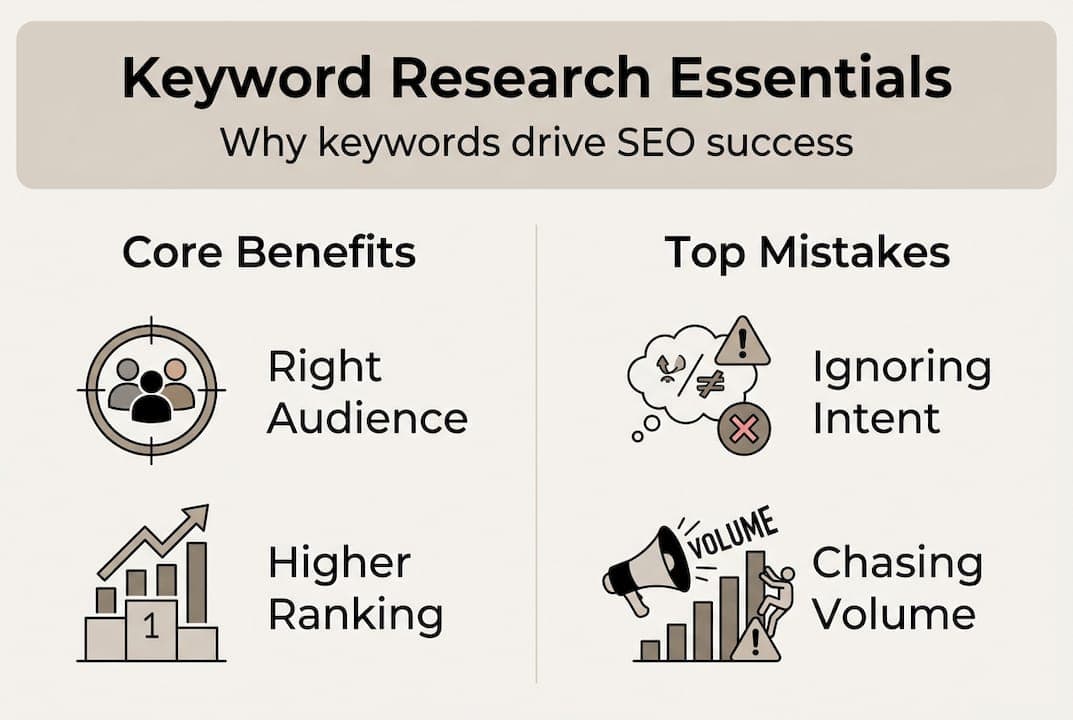
Key stat: Pages targeting long-tail keywords consistently show higher engagement rates and lower bounce rates because the content matches exactly what the user was looking for.
Skipping keyword research, or relying only on gut instinct, creates a different problem. You end up publishing content that competes in categories where you have no realistic chance of ranking, while missing easier wins in adjacent topics. Using AI-powered keyword discovery helps surface those overlooked opportunities systematically.

Pro Tip: Do not evaluate keywords by volume alone. Score each term by the estimated revenue impact if you ranked on page one. A keyword with 200 monthly searches and high purchase intent is worth more than a 10,000-search term with no commercial relevance.
Keyword research also amplifies performance across every organic channel. Blog posts, product pages, landing pages, and even meta descriptions all benefit from intent-aligned language. Understanding the SEO impact of relevant keywords means recognizing that every piece of content is an opportunity to answer a specific question your audience is already asking.
Common pitfalls and misconceptions
Even experienced SEO practitioners make avoidable mistakes in keyword research. The most damaging ones are not technical errors. They are strategic blind spots that compound over time.
Here are the most common pitfalls, ranked by how often they derail campaigns:
- Ignoring search intent. Targeting a keyword without understanding why someone searches it leads to content that ranks but does not convert. A user searching "project management" might want a definition, a tool comparison, or a job listing. Each requires a completely different page.
- Volume obsession. High-volume keywords feel like big prizes. But common mistakes include volume obsession and neglecting intent, which leaves marketers chasing terms they cannot realistically rank for while ignoring more achievable opportunities.
- Skipping topical context. Treating keywords as isolated terms rather than parts of a broader topic ecosystem means missing the semantic signals search engines use to evaluate authority.
- Neglecting to update research. Keyword landscapes shift. New terms emerge, intent changes, and competitor content evolves. Research done 18 months ago may no longer reflect how your audience searches today.
- Overlooking zero-volume keywords. A keyword showing zero monthly searches in a tool is not necessarily worthless. It may reflect a niche query with real purchase intent that tools simply have not indexed yet.
"The keywords your customers use in support tickets, sales calls, and product reviews are often more valuable than anything a keyword tool surfaces."
Pro Tip: Before finalizing your keyword list, manually search each term and study the results page. The format and type of content Google ranks tells you exactly what intent it has assigned to that query. Match your content format accordingly.
Using AI-driven search strategies helps avoid these traps by automating intent classification and flagging topical gaps before you commit to a content plan.
Integrating AI and advanced tools into keyword research
The gap between marketers who use AI in their keyword research and those who do not is widening fast. AI tools do not just speed up the process. They surface patterns and opportunities that manual research would miss entirely.
| Feature | Traditional tools | AI-powered tools |
|---|---|---|
| Keyword volume data | Yes | Yes |
| Intent classification | Manual | Automated |
| Topical cluster mapping | Manual | Automated |
| Semantic variation discovery | Limited | Extensive |
| Competitive gap analysis | Basic | Deep, real-time |
| Content brief generation | No | Yes |
AI enhances keyword research by surfacing topic clusters, intent signals, and SEO gaps, but strategic human analysis remains vital. The tool does not decide which opportunities align with your business goals, your audience's stage in the buying journey, or your content team's capacity. You do.
Here is how to integrate AI tools effectively into your workflow:
- Start with seed terms from your product, service, and customer language.
- Run AI clustering to group related terms into content themes automatically.
- Layer in intent analysis to classify each cluster by user goal.
- Use gap analysis to identify topics competitors cover that you do not.
- Validate with human review before committing to a content calendar.
Exploring AI-powered keyword research platforms gives you a clear picture of how automation changes the speed and depth of discovery. Understanding how AI search engines in SEO evaluate and rank content helps you align your keyword strategy with the platforms your audience actually uses. And building AI content workflows around your keyword data can cut research time significantly while improving output consistency.
Why the best keyword research starts with curiosity, not just tools
Here is something most SEO guides skip: the best keyword insights rarely come from a tool dashboard. They come from genuine curiosity about your audience.
Too many SEO professionals become tools-driven. They open a platform, pull a list, filter by volume and difficulty, and call it research. But that process only surfaces what competitors are already targeting. It does not reveal what your specific audience is struggling to find, the language they use in real conversations, or the questions they ask before they even know what to search for.
The real competitive edge comes from questioning your assumptions. Why does someone search this term at this moment? What do they already know, and what are they still unsure about? That kind of thinking leads you to keywords and content angles that no tool would surface on its own.
Data and AI should support that curiosity, not replace it. When you learn to optimize content for AI search with a genuine understanding of your audience's needs, the results compound faster than any volume-chasing strategy ever could. Sometimes the highest-ROI keywords are hiding in a customer support thread or a sales call transcript, not in a keyword tool.
Unlock the full power of keyword research with AI-driven tools
Understanding keyword research strategy is one thing. Executing it at scale, consistently, across dozens of content categories is where most teams hit a wall. That is exactly the gap that AI-powered platforms are built to close.
At Babylovegrowth.ai, we built our AI keyword research tool to surface high-value opportunities your competitors have not found yet. Our keyword discovery platform automates the process of finding intent-aligned terms across your entire topic space, while our keyword clustering tool organizes them into actionable content themes. If you are ready to move from theory to results, these tools give your team the infrastructure to do it faster and smarter.
Frequently asked questions
What is the main goal of keyword research?
The main goal is to identify search terms your audience uses to find solutions you provide, bridging user intent and your website content. Keyword research informs content strategy and ensures every page you publish serves a real audience need.
How does keyword research impact organic search rankings?
It ensures your site targets the right queries, increasing chances of ranking higher for valuable, relevant searches. Keyword specificity and quality improve click and conversion rates beyond what broad targeting achieves.
Can AI replace manual keyword research?
AI enhances keyword discovery and analysis, but human strategy and audience understanding remain irreplaceable. AI enhances but does not replace the strategic foundation that makes keyword research effective.
What are common mistakes in keyword research?
Over-focusing on volume, ignoring search intent, and skipping topical research are key pitfalls. Common mistakes include volume obsession and neglecting the intent signals that determine whether a page actually converts visitors.
Why do low-volume keywords matter?
Low-volume keywords often signal high purchase intent and yield better conversions than broad, high-volume terms. Long-tail and zero-volume keywords often convert better in competitive spaces where broad terms are dominated by established players.